This is Part 4 of 4 in the Cognitive Enhancement Series (the clean, natural daily engine). The full path:
- Part 1 — Foundation (2 sub-articles):
- Part 1.0: The Cognitive Architecture (the two buckets, the six pathways, and how to measure them)
- Part 1.1: Signal and Noise (why more stimulation isn’t more output)
- Part 2 — The Base:
- Part 2.0: The Behavioral Base (the 90% that comes before any compound, and where it ladders in your life)
- Part 3 — Pharmacology (2 sub-articles):
- Part 3.0: Cognitive Performance (the active software stack, by tier)
- Part 3.1: Neural Preservation (the hardware and the baseline, by tier)
- Part 4 — Application (4 sub-articles):
- Part 4.0: The Escalation Protocol (the guiding framework: when and how to escalate)
- Part 4.1 (this article): The Natural Stack (the clean daily engine, built, timed, and costed)
- Part 4.2: The Enhanced Stack (experimental & prescription compounds, by tier)
- Part 4.3: The Hybrid Stack (how to mix natural + enhanced)
Table of Contents
- What we’re building
- The bio-circuit: how the natural stack connects
- The base stack: 13 ingredients, by job
- Dosage optimisation: getting each one right
- The pre-made trap: one scoop forces a compromise
- Synergy and redundancy: what to add, what to skip
- Timing: building the stack around your day
- The two-tier operational roadmap
- The cost model: what the stack actually costs per month
- Part 4 Takeaways
- Your Build Task List
- Sources & references
This is the whole machine, built from legal parts
Everything in this article is Tier 2 (Premium OTC) from Part 3.0: amino acids, choline, herbs, a nucleotide, fish oil. No prescriptions, no research chemicals. This is deliberately the complete, self-sufficient stack: the daily engine you can run for years. Most people never need anything past this article. The heavy pharmacology (racetams, peptides, prescription stimulants) lives in Part 4.2, and it’s an optional overlay on this base, not a replacement for it. If you haven’t passed the behavioural gate, a perfect stack still won’t save you.
What we’re building
A real, daily, full-spectrum natural stack that touches every lever from the architecture: dopamine fuel, cellular energy, choline (fuel + brake), structural membrane-building, blood flow, mood, and neurogenesis. We’ll first see how the parts connect into one machine, then build it ingredient by ingredient, dose it correctly, sort the genuinely useful additions from the redundant, split it into a daily-vs-heavy-day protocol, and cost it honestly in ringgit.
Prices here are illustrative
The ringgit figures use Nutricost on iHerb as one concrete, mid-priced reference, to show method and ratio rather than to quote a live price. iHerb prices move and vary by promotion, so check the current figures yourself. Your actual numbers will differ; the logic is what transfers.
The bio-circuit: how the natural stack connects
Before the shopping list, see the system. A stack isn’t a pile of pills; it’s an engine, and every part has a job that only makes sense in relation to the others. You can’t just stamp the accelerator (stimulants) if you have no fuel lines, no coolant, no wiring, and no chassis.
       [ ENGINE FUEL & POWER ]                      [ ELECTRICAL TRANSMISSION ]
       Creatine  ──► ATP battery                     Alpha-GPC ──► acetylcholine base
       Tyrosine  ──► catecholamines (dopamine)       ALCAR     ──► acetyl donor + mito energy
       Caffeine  ──► ignition (adenosine block)      Huperzine ──► acetylcholine shield
          │                                             │
          ▼                                             ▼
[ MONOAMINE MODULATOR / MOOD ]               [ INFRASTRUCTURE & REPAIR ]
Saffron ──► keeps dopamine/serotonin          Uridine + CDP-choline + DHA
           in the synapse longer                ──► membrane growth (Kennedy pathway)
          │                                             │
          ▼                                             ▼
 [ HYDRAULICS & BLOOD SUPPLY ]                 [ HARDWARE / NEUROGENESIS (BDNF) ]
 Ginkgo  ──► widens the pipeline               Lion's Mane + Bacopa ──► new wiring
Walk it as a six-act sequence; this is the storyline that makes the protocol below obvious rather than arbitrary.
Act I: Fuel and power (Creatine, ALCAR, Tyrosine). The system starts with resource allocation. Creatine is your cellular battery, recycling ATP so neurons don’t brown out under heavy mathematical or creative load.1 L-Tyrosine is the crude oil: it converts into L-DOPA → dopamine → norepinephrine, the catecholamines behind drive, focus, and urgency, and it shines most at replenishing those stores under stress. ALCAR (Acetyl-L-Carnitine) is an acetyl-group donor that feeds both acetylcholine synthesis and mitochondrial energy production, turning the battery into usable horsepower and clearing brain fog.
Act II: Wiring and the learning network (the Kennedy pathway + Bacopa). With raw energy online, the brain needs a stable communication network. Uridine + CDP-choline + DHA (from fish oil) combine via the Kennedy pathway to build phosphatidylcholine, the actual physical membranes of your neurons (Part 3.1). All three are required; this is the trinity from Part 2.0. Alongside them, Bacopa Monnieri strengthens synaptic transmission and memory consolidation, slowly, over weeks.
Act III: High-volume logistics (Ginkgo). Energy and wiring are useless if nutrients can’t move. Ginkgo Biloba acts as a mild vasodilator, widening cerebral vessels so oxygenated blood (carrying every other compound) reaches the prefrontal cortex efficiently. (The human evidence here is modest; treat it as a reasonable, low-risk delivery aid, not a hero.)
Act IV: The spark and the alpha-wave regulator (Caffeine + L-Theanine). Now you turn the key. Caffeine blocks adenosine receptors: it hides fatigue and, by lifting that brake, lets your existing dopamine/norepinephrine signalling run higher. (Note: it disinhibits, it doesn’t force a dump the way an amphetamine does, which is exactly why it’s the Tier-2 base and they’re not.) To stop the spark blowing up the engine, L-Theanine raises alpha brain waves and GABA, deleting the jitters and the blood-pressure spike and leaving smooth, relaxed clarity. The 2:1 theanine-to-caffeine ratio is the whole trick.
Act V: The acetylcholine transmission guard (Alpha-GPC + Huperzine-A). Firing on all cylinders, your learning neurotransmitter acetylcholine gets consumed fast. Alpha-GPC is the fast delivery vehicle, pushing choline past the blood-brain barrier to raise acetylcholine. Huperzine-A is the defensive shield: it blocks acetylcholinesterase (the enzyme that eats acetylcholine), so your memory and processing speed stay sharp for hours. Fuel + brake together is powerful, and exactly why you must not overdo both (cholinergic overload) and must cycle the Huperzine.
Act VI: Mood and neurogenesis (Saffron + Lion’s Mane). To stay resilient and creative, Saffron behaves like a reuptake inhibitor, keeping serotonin and dopamine active in the synapse longer, stabilising mood and blunting frustration-fatigue. And deep in the core, Lion’s Mane (a real, concentrated extract, not cheap starch-filled “biomass”) triggers NGF/BDNF synthesis, growing new connections out of the structural substrates Act II supplied.
The nitrous button: nicotine
For a genuine high-stakes emergency, a 1–2 mg nicotine lozenge/gum is the nitrous override (Part 3.0): a direct nicotinic-acetylcholine agonist that also floods dopamine. Because your stack has already maxed acetylcholine and shielded it with Huperzine, the nicotine opens a floodgate of focus. Tactical only: 1–2 mg, not daily. Treated as a habit it becomes the cheap-dopamine problem Part 2.0 worked to drain.
The base stack: 13 ingredients, by job
Here’s the engine as a parts list, each tagged to its pillar so you can see it’s not random; it’s one tool per job.
| Ingredient | Pillar (from Part 1.0) | Act | What it does here |
|---|---|---|---|
| L-Tyrosine | Executive Function (dopamine fuel) | I | Raw precursor for dopamine under stress/high output |
| Creatine | Cellular energy (preservation) | I | ATP buffer; reduces mental fatigue, esp. when under-slept |
| ALCAR (Acetyl-L-Carnitine) | Memory + mitochondrial energy | I | Acetyl donor for acetylcholine; clears fog |
| Uridine monophosphate | Preservation (structural) | II | Synaptic membrane building block (Kennedy pathway) |
| CDP-choline (or Alpha-GPC) | Memory (choline fuel) | II / V | Choline base + cytidine→uridine; raw material for acetylcholine |
| Fish oil (high DHA) | Preservation (structural) + base | II | The third leg of the membrane trinity |
| Bacopa Monnieri | Memory + Preservation | II | Long-term memory consolidation; slow-acting |
| Ginkgo Biloba | Blood flow | III | Cerebral circulation; delivers everything else |
| Caffeine | Executive Function (stimulant) | IV | The base arousal driver / ignition |
| L-Theanine | Flexibility / State Control | IV | Removes caffeine’s jitter; the calm half of signal-to-noise |
| Alpha-GPC | Memory (choline fuel, acute) | V | Fast acetylcholine spike on heavy days |
| Huperzine-A | Memory (the brake) | V | Slows acetylcholine breakdown; must be cycled |
| Saffron | Flexibility / State Control (mood) | VI | Reuptake-inhibition-like; emotional lift |
The choline split (a smart cost + physiology move)
Choline appears twice on purpose. CDP-choline (citicoline) is the slower, structural choline: it also yields cytidine that the body converts to uridine, so it synergises with your standalone uridine and supports the Kennedy pathway. Alpha-GPC is the fast, acute choline for immediate focus. The efficient play: run a low daily CDP-choline as the baseline, and save Alpha-GPC for heavy days only. This also sidesteps over-relying on alpha-GPC daily given its TMAO signal, doubly relevant for you, with the cardiovascular load you already carry on cycle.
Dosage optimisation: getting each one right
Most pre-made blends fix ratios for convenience, not clinical optimum. Each ingredient against its evidence-backed daily target:
| Ingredient | Common blend dose | Clinical / optimal target | Verdict |
|---|---|---|---|
| L-Tyrosine | 1,000–2,000 mg | 1,000–2,000 mg | Perfect. Scales cleanly. |
| Creatine | (rarely in blends) | 3–5 g daily | The cognitive dose is 3–5 g, not 20 g; loading is an athletic protocol, not a brain one. |
| Alpha-GPC | 600 mg of “50%” = 300 mg active | 300–600 mg active | Check the math: “50%” means a 600 mg cap yields ~300 mg active. |
| ALCAR | 500–1,000 mg | 500–2,000 mg | Solid. ~1,000 mg is the noticeable sweet spot. |
| Uridine | 200–400 mg | 150–300 mg | Optimal, especially with a choline source + DHA. |
| Fish oil | — | ≥500–1,000 mg actual DHA | Read the DHA line, not total fish-oil weight; that’s the number that feeds the Kennedy pathway. |
| Ginkgo | 180–360 mg | 120–240 mg | Good. 120–180 mg is plenty. |
| Bacopa | 165–330 mg | ~300 mg (50% bacosides) | Underdosed at one serving. Needs ~300 mg+ to work for memory.2 |
| Caffeine | 150–300 mg | 100–200 mg | The bottleneck (see below). |
| L-Theanine | 100–200 mg | ~200 mg (2:1 vs caffeine) | Usually under-ratioed in blends. |
| Huperzine-A | 100–200 mcg | 100–200 mcg | Right dose, must cycle: long half-life, accumulates. |
| Saffron | 15–30 mg | ~30 mg (0.3% safranal) | Effective; standalone bottles often run much higher (~88 mg), so one cap is plenty. |
The fixes that matter most
- The caffeine:theanine ratio. The golden ratio is 2:1 theanine-to-caffeine (e.g. 200 mg theanine / 100 mg caffeine).3 Most blends invert this. Cheapest, highest-impact tweak in the whole stack.
- Cycle the Huperzine-A (weekdays on, weekends off); its long half-life means daily use accumulates into headaches and twitches.
- Dose fish oil by DHA, not weight: aim for ≥500–1,000 mg actual DHA. Volume of fat doesn’t matter; DHA content does.
The pre-made trap: one scoop forces a compromise
Pre-made blends are convenient and often well-formulated. Their structural flaw is that the ingredients are locked in one ratio, so to get a clinical dose of the herbs you’re forced to take everything else at that multiple too:
The caffeine handcuff
In a typical blend, the only way to hit optimal Bacopa (300 mg) and Tyrosine (2 g) is to take two servings, which drags caffeine to ~300 mg (three-plus coffees in one hit), meaning jitters and a crash. You end up over-caffeinated just to dose the herbs. A DIY stack separates the stimulant from the structure: the entire case for building it yourself, and exactly what lets you use the focus pieces in the afternoon or on rest days without wrecking sleep.
Synergy and redundancy: what to add, what to skip
Once the base is comprehensive, more is not automatically better; the inverted-U and overload logic from Part 3 applies.
Synergistic: genuinely worth adding
- Omega-3 (EPA/DHA) → foundational, not optional. Already in the base above, but worth restating: it’s the third leg of the uridine + choline trinity, so without it the structural half can’t build membranes, and it boosts the fat-soluble botanicals when taken with them at a meal. Run it daily.
- Lion’s Mane → high value, but buy the right form. Adds a different mechanism (NGF/BDNF neuroplasticity) with no neurotransmitter overlap. Quality is everything here: the active compounds split between hericenones (in the fruiting body) and the more potent erinacines (in the mycelium). Cheap “mushroom powder” or starch-heavy biomass won’t move BDNF; you want a concentrated, standardised extract. Human cognitive evidence is still mixed and slow, so judge it over months (Part 3.1).
- Creatine (3–5 g) → yes. A brain-ATP buffer that reduces mental fatigue, especially under sleep deprivation, and you’re likely already taking it for the gym. Synergises with ALCAR on mitochondrial energy.
- Phosphatidylserine (PS) → situational synergy. A structural phospholipid that supports membrane fluidity and blunts cortisol spikes: a “smoother” alongside L-theanine, and it supports the membrane-building that makes uridine work.
Redundant or risky: skip
- DMAE → skip. Another route to raising acetylcholine, which you’re already hitting hard with your choline source (fuel) and Huperzine-A (brake). Stacking DMAE risks cholinergic overload: depressive dips, jaw clenching, muscle stiffness, heavy fog. Pure redundancy with downside.
- Pregnenolone / DHEA → not a casual add. Potent hormones that shift your endocrine baseline (Part 3.1). If you’re on cycle and suspect neurosteroid-depletion fog, that’s a test-first, supervised correction, not a stack ingredient.
The special case: Rhodiola Rosea (a “swing weapon,” not a daily driver)
Synergistic in mechanism, redundant in its goal, and easy to overdo
Rhodiola is a mild MAO inhibitor (slows the breakdown of dopamine/norepinephrine/serotonin). Saffron is a reuptake inhibitor (blocks their recycling). They hit the same target from opposite ends, so stacking them on top of L-Tyrosine (raw material) and caffeine (the spark) maxes out the entire monoamine life cycle at once, which for a normal-dopamine brain can tip into hyper-noradrenergic territory (racing heart, cold hands, irritability, “wired-but-tired”). Use it as a swing weapon for high-stress, low-sleep days, start low (100–250 mg), and pick a 3% rosavins / 1% salidroside extract (rosavins calmer; high-salidroside jittery). Its anti-fatigue evidence is real but trial quality is inconsistent.2
The natural BDNF ceiling-breaker, if you hit a wall
If, after a month on this stack, you’ve hit a genuine cognitive ceiling and want a stronger natural neurogenesis push than Lion’s Mane, Polygala tenuifolia (Yuan Zhi) is the most interesting candidate: a TCM herb that upregulates BDNF and NGF and supports acetylcholine in animal and early human work (preliminary, so treat it as promising, not proven). It’s the natural bridge toward the experimental BDNF peptides in Part 4.2; add it before you ever consider those.
Timing: building the stack around your day
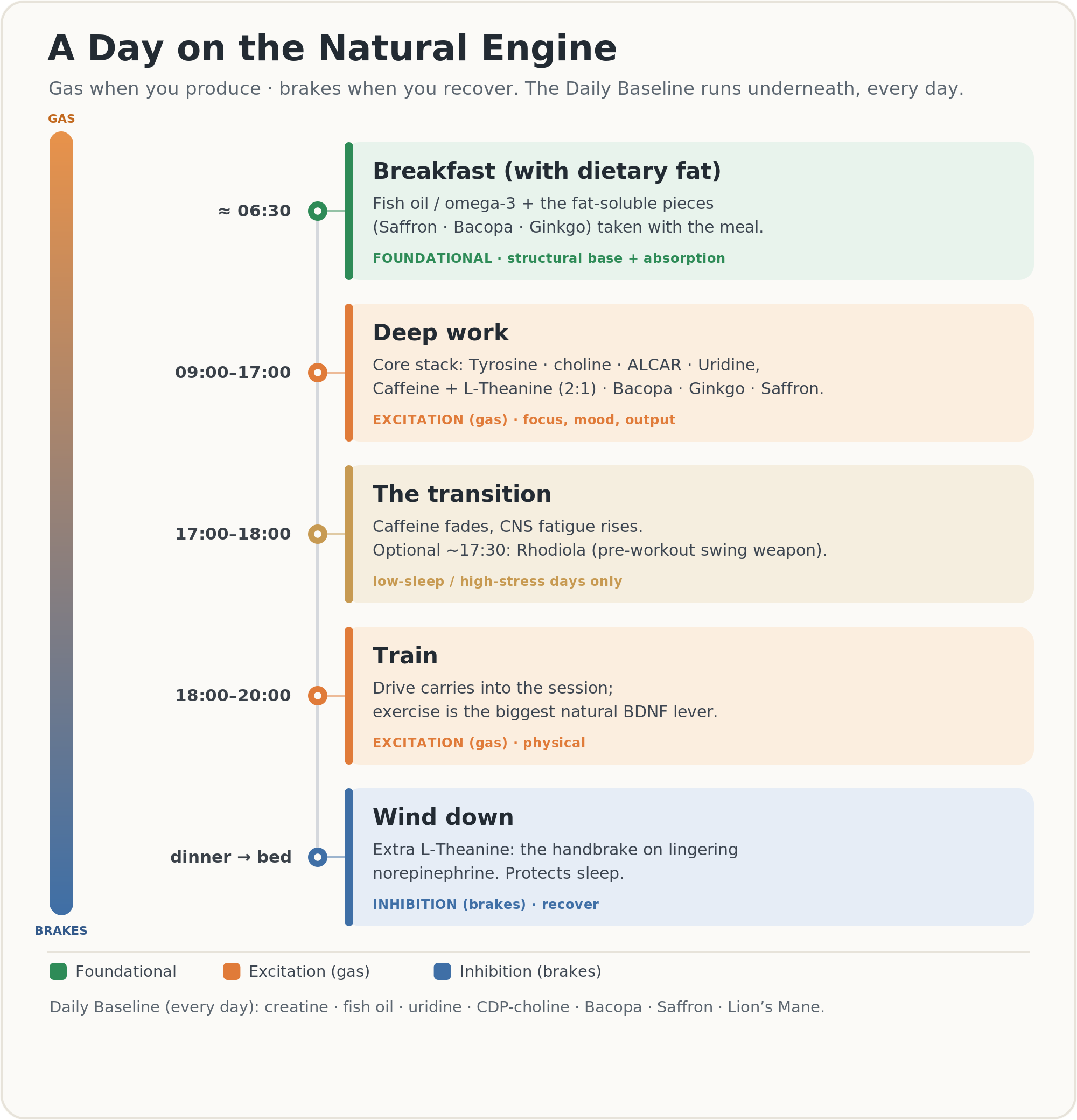
The upgrade from a static stack (everything fighting for dominance at 9 AM) to a dynamic one that follows your day’s demands. The model assumes your real schedule: deep work 9–5, train at 6 PM, sleep ~11 PM.
The shape of the day follows the gas-and-brakes arc from Part 1.1: a calm foundational layer underneath everything, excitation stacked on top during your produce-windows, and inhibition deliberately raised in the evening to recover. Three blocks:
- Foundational (all day): the stimulant-free structural base (omega-3, creatine, choline, uridine, Bacopa, Saffron), the floor that the gas and brakes both sit on.
- Excitatory (morning–afternoon, produce-windows): the gas (caffeine + tyrosine + the acute choline) paired with theanine so you sit near your inverted-U peak, not past it.
- Inhibitory (evening, recover): the brakes, winding excitation down, with L-theanine as the handbrake into sleep. You raise the gas when you produce and the brakes when you recover; flooring the gas all day is the burnout path.
Splitting Saffron (AM) and Rhodiola (PM): the mechanics
- Saffron in the morning anchors mood and focus through the workday; its long half-life keeps a smooth background lift running by 6 PM.
- Rhodiola at ~5:30 PM is a transitional bridge: it counters the central-nervous-system fatigue of a long mental day and the fading-caffeine dip, so you walk into training with drive after eight hours at a desk. It also supports ATP/glycogen, pairing with your creatine.
- Staggering them captures the mechanism synergy (Saffron’s lingering reuptake-block + Rhodiola’s MAO-inhibition) without the jittery peak of swallowing both at once.
The sleep caveat on an evening Rhodiola
Rhodiola keeps norepinephrine active, the exact chemical that wakes the brain up. A potent extract at 5:30–6 PM can leave you physically exhausted but mentally racing at 11 PM. Two defences: (1) keep the pre-workout dose small (100–200 mg) and rosavin-dominant; (2) ==take your L-theanine post-workout / pre-bed==, where it raises GABA and turns off the lingering norepinephrine push, easing you into deep sleep (Sleep series).
The two-tier operational roadmap
This is the payoff: a structure that builds brain structure every day but only unleashes the high-performance machine when there’s output to produce, so your receptors never down-regulate and your expensive bottles last.
🟢 Tier 1: The Daily Baseline (7 days a week)
Objective: build physical brain structure, protect membranes, manage mood, and grow new wiring, without touching stimulants. This runs every single day, including rest days.
| Compound | Dose & timing | Why it’s here |
|---|---|---|
| Creatine monohydrate | 3–5 g, anytime | Keeps the cellular ATP battery saturated |
| Fish oil (high DHA) | Morning, with food | Supplies the DHA leg of the Kennedy pathway |
| Uridine monophosphate | Morning | Builds cell membranes with fish oil + choline |
| CDP-choline | Morning, low dose | Foundational daily choline + cytidine→uridine |
| Bacopa Monnieri | Evening, with food | Must accumulate over 4–6 weeks for structural memory gains |
| Saffron | Morning or night | Keeps serotonin/dopamine stable; holds baseline mood high |
| Lion’s Mane (real extract) | Morning | Continuously feeds BDNF/NGF neurogenesis |
🧠 Tier 2: The Heavy Execution Day (4–5× a week)
Objective: maximise raw horsepower, executive function, processing speed, and training capacity. Skip on weekends / rest days: that’s the reset that protects your receptors and your wallet. Layer these on top of the Daily Baseline:
| Compound | Dose & timing | Why it’s here |
|---|---|---|
| L-Tyrosine | 2,000 mg, empty stomach, on waking | Floods dopamine reservoirs |
| ALCAR | 1,000 mg | Mitochondrial energy + fog clearance |
| Alpha-GPC | 600 mg | Acute acetylcholine spike for focus |
| Ginkgo Biloba | 120–240 mg | Opens cerebral blood flow to deliver the stack |
| Caffeine + L-Theanine | 100 mg + 200 mg | The smooth 2:1 ignition trigger |
| Huperzine-A | 200 mcg | Locks the enzyme door so acetylcholine holds all day |
| (optional, pre-workout) Rhodiola | 100–200 mg, ~5:30 PM | Swing weapon for low-sleep / high-stress days |
| (emergency only) Nicotine gum | 1–2 mg, during a strict deadline block | The nitrous override; never daily |
The rest days protect your brain and your wallet
Dropping the Heavy modules on your 2–3 low-intensity days does three things at once: your caffeine tolerance resets, your Huperzine-A clears (preventing headaches/twitches from accumulation), and your Alpha-GPC and Tyrosine bottles stretch far longer. You build structure every day; you only spend the stimulants when there's a result to produce. This is the Performance-vs-Preservation split turned into a weekly calendar.
The Golden Rule of the whole stack: never max a single compound
Notice what every dose in both tiers has in common: they’re modest. This is the most important operating principle in stack-building, and it falls straight out of the inverted-U: ==you get a better, more flexible cognitive state from modest amounts of several complementary inputs than from a maximum dose of any single one.== Precursor (Tyrosine) + metabolic optimiser (ALCAR) + a small breakdown-inhibitor (Huperzine) + the calming balancer (Theanine), each at a sensible dose, layer into a smooth, balanced state. Megadosing any one of them shoves you over your peak and floods you with the jitters, crash, and tolerance that wreck long-term output. Low-dose synergy beats max-dosing, always. It’s also why the natural stack works at all: a dozen-plus modest inputs covering every pathway will out-perform one heroic dose of a single “hero” compound every time.
The cost model: what the stack actually costs per month
The same framing as the PE finale: the real question isn't the upfront price, it's the true monthly burn rate. The bottles empty at wildly different rates, so the big upfront number is misleading. We’ll cost the actual two-tier protocol, not a generic shopping list, using Nutricost on iHerb as the illustrative reference.
Step 1: The upfront cash-out (the full kit, illustrative Nutricost / iHerb RM)
| Ingredient | Nutricost pack (illustrative) | Price (RM) | Runs on | Pack lasts ~ |
|---|---|---|---|---|
| L-Tyrosine | 500 g powder | 114 | heavy days | ~12 months |
| Creatine | 500 g powder | 70 | daily | ~3 months |
| Fish oil (high DHA) | 120 softgels | 50 | daily (2/day) | ~2 months |
| Uridine monophosphate | 60 caps | 78 | daily | ~2 months |
| CDP-choline | 60 caps | 85 | daily | ~2 months |
| Bacopa | 120 caps | 69 | daily | ~4 months |
| Saffron | 240 caps | 82 | daily | ~8 months |
| Lion’s Mane (concentrated extract) | 60 caps | 90 | daily | ~2 months |
| ALCAR | 180 caps | 78 | heavy days | ~4 months |
| Alpha-GPC | 120 caps | 73 | heavy days | ~3 months |
| Ginkgo | 240 caps | 61 | heavy days | ~11 months |
| Caffeine | 250 caps | 49 | heavy days | ~12 months |
| L-Theanine | 120 caps | 49 | heavy + pre-bed | ~4 months |
| Huperzine-A | 240 caps | 82 | heavy days | ~11 months |
| Upfront total | ~RM 1,030 | (+ ~RM 50 optional Rhodiola) |
That ~RM 1,030 is the scary number, and it’s also the misleading one, because almost none of it recurs monthly.
Step 2: Component lifespans (why upfront ≠ monthly)
The bottles do not empty together:
- Fast-movers (restock every ~2 months): Fish oil, Uridine, CDP-choline, Lion’s Mane. These are all in the Daily Baseline, and they are the bulk of your real spend.
- Mid (~3–4 months): Creatine, Alpha-GPC, Bacopa, ALCAR, L-Theanine.
- Long-lasters (~8–12 months, buy once or twice a year): Saffron, Ginkgo, Caffeine, Huperzine-A, and the L-Tyrosine powder.
==The counterintuitive part: the daily structural items are your fast-movers, while the heavy-day stimulant capsules last most of a year.== The brain-building half is where the money goes, not the “smart drug” half.
Step 3: Costing the two tiers (weekly → monthly)
Now cost the actual schedule. The Daily Baseline runs 7 days a week; the Heavy Execution overlay runs ~5.
🟢 Daily Baseline (×7 / week):
| Compound | Dose | RM/day | RM/week |
|---|---|---|---|
| Creatine | 5 g | 0.70 | 4.90 |
| Fish oil (high DHA) | 2 softgels | 0.83 | 5.81 |
| Uridine | 250–300 mg | 1.30 | 9.10 |
| CDP-choline | 250 mg | 1.42 | 9.94 |
| Bacopa | 500 mg | 0.58 | 4.06 |
| Saffron | 88.5 mg | 0.34 | 2.38 |
| Lion’s Mane | extract, 1 cap | 1.50 | 10.50 |
| Baseline subtotal | ~RM 47 / week |
🧠 Heavy Execution overlay (×5 / week, on top of baseline):
| Compound | Dose | RM/day | RM/week |
|---|---|---|---|
| L-Tyrosine | 2 g | 0.46 | 2.30 |
| ALCAR | 1 g | 0.87 | 4.35 |
| Alpha-GPC | 600 mg | 1.22 | 6.10 |
| Ginkgo | 120 mg | 0.25 | 1.25 |
| Caffeine | 100 mg | 0.20 | 1.00 |
| L-Theanine | 200 mg | 0.41 | 2.05 |
| Huperzine-A | 200 mcg | 0.34 | 1.70 |
| Heavy subtotal | ~RM 19 / week |
Optional extras: pre-workout Rhodiola ~RM 0.80 × 3 days ≈ RM 2.5/week. (Nicotine, emergency-only, is negligible.)
What you actually spend
- Weekly: ~RM 47 (baseline) + ~RM 19 (heavy) ≈ RM 66/week core, or ~RM 68 with the optional Rhodiola.
- Monthly (× 4.3): ≈ RM 285/month all-in core (~RM 295 with Rhodiola).
- The split is the real lesson: the Daily Baseline structural stack is ~RM 200/month (Lion’s Mane, CDP-choline, uridine, and fish oil dominate it), while the Heavy-Day performance overlay is only ~RM 80/month. The "smart drug" half is the cheap half; the brain-building half is where the money goes.
The honest cost hierarchy (same as the PE series)
The PE finale makes the point that ==the gear is the cheap recurring part of a sensible protocol==: food, gym, and fast-moving consumables dominate the budget. Same here. At ~RM 285/month all-in, the stack sits roughly level with a serious food and training spend, and the biggest line items are the daily structural consumables, not the stimulants. And the highest-ROI “purchase” of all, fixing sleep and your dopamine baseline, costs nothing.
Part 4 Takeaways
Key concepts to internalise
- The stack is an engine, not a pile. Fuel (creatine/tyrosine/ALCAR) → wiring (uridine+choline+DHA, Bacopa) → logistics (ginkgo) → spark (caffeine+theanine) → acetylcholine guard (alpha-GPC+huperzine) → mood & neurogenesis (saffron, Lion’s Mane). Each part only makes sense in relation to the others.
- This whole article is Tier 2. A complete, legal, sustainable daily engine; most people never need Part 4.2.
- Split your choline: low daily CDP-choline (structural + uridine synergy) as baseline; Alpha-GPC reserved for heavy days (also sidesteps daily-alpha-GPC’s stroke signal).
- Dose for the optimum: 2:1 theanine:caffeine, Bacopa ~300 mg, fish oil by DHA content (≥500 mg), and cycle Huperzine-A.
- Run two tiers: a stimulant-free Daily Baseline (structure, mood, neurogenesis) 7 days a week; a Heavy Execution Day overlay 4–5×/week. The rest days reset tolerance and stretch the budget.
- Add Lion’s Mane (real extract), creatine, PS; skip DMAE; Rhodiola is a swing weapon; Polygala is the natural ceiling-breaker; pregnenolone/DHEA are test-first hormones.
- Cost is monthly burn, not upfront. The full two-tier protocol runs ~RM 285/month all-in (Nutricost/iHerb, illustrative), and the surprise is that the daily structural stack (Lion’s Mane, CDP-choline, uridine, fish oil) costs far more than the stimulant half, which is cheap and lasts most of a year.
Your Build Task List
- Audit your intake against the dosage table. Fix the theanine:caffeine ratio first; it’s the cheapest win.
- Set the choline split: low daily CDP-choline as baseline, Alpha-GPC reserved for heavy days.
- Lock in the dietary base: daily fish oil (≥500 mg DHA), creatine 3–5 g, and take the fat-soluble pieces with a fatty meal.
- Build the two-tier calendar: the stimulant-free Daily Baseline every day; the Heavy Execution overlay only on your 4–5 real output/training days.
- Add only Lion’s Mane (real extract) to start beyond the base; resist piling on. Hold Polygala/Rhodiola for a demonstrated ceiling.
- Run it as a single-variable experiment and judge it on the numbers over 3–4 weeks, then, and only then, consider whether Part 4.2 is worth opening.
Up next
This is the complete natural machine. Part 4.2 — The Enhanced Stack takes these exact six pathways and shows what changes when you layer experimental and prescription compounds on top: racetams, peptides (Noopept, Semax, the heavily-flagged Dihexa), and the Tier-1 eugeroics/stimulants, with the honest risk accounting each one demands.
Disclaimer
This article is educational and is not medical advice. Even OTC supplements interact with medications and conditions: Bacopa, Ginkgo, and Saffron can affect bleeding/anticoagulation; 5-HTP and Saffron interact with serotonergic drugs (serotonin-syndrome risk); Rhodiola’s MAO-inhibition can interact dangerously with other medications; pregnenolone/DHEA alter your endocrine baseline; high-dose daily alpha-GPC carries an observational stroke-risk signal. Nicotine is addictive. Prices are illustrative (Nutricost on iHerb) and move over time. Consult a qualified doctor or pharmacist before combining supplements, especially alongside any prescription medication or an active cycle.
Sources & references
Footnotes
-
Avgerinos, K.I. et al. (2018), “Effects of creatine supplementation on cognitive function of healthy individuals: A systematic review of randomized controlled trials,” Experimental Gerontology 108:166–173. Creatine supports short-term memory and reasoning, with the clearest benefit under stress such as sleep deprivation; cognitive dosing 3–5 g/day. On uridine + DHA + choline synaptic membrane synthesis (Kennedy pathway), see Wurtman, R.J. et al. (2009), Brain Research 1264:130–140. ↩
-
Kongkeaw, C. et al. (2014), “Meta-analysis of randomized controlled trials on cognitive effects of Bacopa monnieri extract,” Journal of Ethnopharmacology 151(1):528–535. Bacopa improves memory free recall and attention speed; effective doses standardised to bacosides ~300 mg/day, effects building over weeks. PubMed 24252493. For Rhodiola’s anti-fatigue effects (with the caveat that trial quality is inconsistent), see Ishaque, S. et al. (2012), “Rhodiola rosea for physical and mental fatigue: a systematic review,” BMC Complementary and Alternative Medicine 12:70 PMC3541197. ↩ ↩2
-
Owen, G.N. et al. (2008), “The combined effects of L-theanine and caffeine on cognitive performance and mood,” Nutritional Neuroscience 11(4):193–198; and Giesbrecht, T. et al. (2010), Nutritional Neuroscience 13(6):283–290. The caffeine + L-theanine combination improves attention and reduces jitter, commonly dosed around a 2:1 theanine:caffeine ratio. ↩