This is Part 2 of 5 in the Sleep Series — the behavioural layer that sits on top of the room you built in Part 2.0. The full path:
- Part 1: The Architecture of Sleep — what sleep is and what it’s for
- Part 2 — The Setup (2 sub-articles):
- Part 2.0: The Environment — building the room that does the work for you
- Part 2.1 (this article): The Pre-Sleep Protocol — the last four hours are the start of sleep
- Part 3 — Pharmacology (2 sub-articles):
- Part 3.0: Natural & OTC Support — the supplement layer, only after the basics
- Part 3.1: The Pharmacological Reset — DORAs, trazodone, and the 30-day rebuild
Table of Contents
- The thesis: sleep starts four hours early
- The master control: a fixed wake time + morning light
- Caffeine: the cutoff that matters most
- Alcohol: the great sleep deceiver
- Food: the last meal and the late-workout problem
- Training and lowering your resting heart rate
- Light: dim the world after sunset
- The temperature trick: a hot shower 90 minutes out
- The wind-down: down-regulating a racing mind
- Naps, and waking at 3 AM
- The four-hour runway
- Part 2.1 Takeaways
- Your Protocol Task List
- Sources & references
The mistake this whole article corrects
Almost everyone treats sleep as a light switch — awake, awake, awake, then click, asleep at 11 PM. So they live at full intensity until the moment their head hits the pillow and then wonder why they’re “tired but wired.” Sleep is not a switch. It's a runway you descend, and the descent starts hours before takeoff. This article is that descent.
The thesis: sleep starts four hours early
The environment is passive — set it once. The protocol is active: it’s the set of things you do (and stop doing) in the hours before bed to let your nervous system descend into sleep. And the single reframe that makes all of it click is this:
==The last ~4 hours of your day are not “evening.” They are the beginning of sleep.==
Your body needs a runway to transition from the sympathetic, alert, problem-solving daytime state into the parasympathetic, calm, switched-off state that permits sleep (recall from Part 1.0: you don’t take sleep, you build the conditions for it). Core temperature has to start falling. Cortisol and adrenaline have to come down. Melatonin has to rise. Sleep pressure has to be high and unspent. None of that happens instantly — it happens across the runway. If you’re answering Slack at 10:55 and lying down at 11:00, you’ve given your physiology zero runway and you’ll spend the first hour of “sleep” still landing.
So the protocol is organised around that runway. Some pieces are all-day habits (wake time, caffeine, training); most cluster into the final four hours.
The master control: a fixed wake time + morning light
Counter-intuitively, the most powerful lever over tonight’s sleep is what time you got up this morning and what light you saw.
- Fix your wake time — every day, including weekends. Your circadian clock (Part 1.0) craves regularity, and wake time anchors the whole clock more reliably than bedtime does. A consistent wake time means sleep pressure builds on schedule and you get sleepy at a consistent hour. The “sleep in till noon Sunday” habit creates social jet lag — you’ve flown your clock three time zones west, and Monday night’s insomnia is the jet lag. Pick a wake time you can hold 7 days a week and hold it.
- Get bright light into your eyes early. Morning sunlight is the strongest signal that tells your clock “the day has started,” which sets the timer for melatonin to rise ~14–16 hours later — i.e., at a sensible bedtime. 10–20 minutes of outdoor light within an hour of waking (more on an overcast day) is the goal. Outdoor light even under clouds is many times brighter than indoor lighting; standing at a window is far weaker than stepping outside. In Malaysia this is easy and free — a short morning walk, coffee on the balcony, or just commuting with the sun on your face.
The two-ended light strategy
Part 2.0 told you to make the night dark. This is the other end: make the morning bright. Bright mornings + dark evenings is the single most effective non-drug circadian intervention there is, and it’s the foundation the Part 3.1 reset hands back to once the drugs come off. Light is the master dial. Use both ends of it.
Caffeine: the cutoff that matters most
Back to Part 1.0: adenosine builds all day and creates the pressure to sleep. Caffeine works by blocking the adenosine receptor — it doesn't reduce your tiredness, it hides it from you. The pressure is still there; you just can’t feel it. When the caffeine clears, the accumulated adenosine floods back (the “caffeine crash”).
The problem for sleep is half-life. Caffeine’s half-life is roughly 5–6 hours, meaning a 3 PM coffee still has ~half its caffeine in your system at 9 PM and a quarter at ~2 AM. A controlled study found that 400 mg of caffeine taken even 6 hours before bed measurably reduced total sleep — and crucially, the subjects often didn’t notice, because caffeine degrades deep sleep without necessarily stopping you falling asleep.1 You can “sleep fine” on a late coffee and still get a shallower, less restorative night.
- The rule: cut caffeine by early afternoon — roughly 8–10 hours before bed. For an 11 PM bedtime, that’s a ~1–2 PM hard stop on coffee, tea, energy drinks, pre-workout, and the caffeine in dark chocolate.
- Pre-workout is the sneaky one. A late-afternoon or evening gym session fuelled by a 200–300 mg pre-workout is one of the most common self-inflicted causes of “I trained hard, why can’t I sleep?” If you train late, go caffeine-free or use a stim-free pre-workout (citrulline, beta-alanine — see the Fit series’ Tier 1).
- Sensitivity is genetic. Some people clear caffeine fast (CYP1A2 fast metabolisers) and tolerate later cups; most don’t and overestimate their tolerance. If your sleep is bad, assume you’re sensitive and test a strict early cutoff for two weeks.
Alcohol: the great sleep deceiver
Alcohol feels like a sleep aid and is one of the worst things you can do to your sleep architecture. It is a sedative, not a sleep-inducer, and the distinction is the whole story.2
- It sedates you into the first half, so you fall asleep faster and sleep deeply early — which is why people believe it helps.
- Then it wrecks the second half. As your body metabolises it, alcohol causes REM suppression and fragmentation — the back-loaded REM that Part 1.0 said does your emotional and cognitive processing gets cut, and you get frequent (often unremembered) awakenings, lighter sleep, more snoring/apnoea, night sweats, and a 4 AM wake-up. You wake feeling unrested even after “8 hours.”
Sedation is not sleep
This is the exact same trap as the Z-drugs in Part 3.1: a chemical that knocks you out is not the same as one that produces natural architecture. If you drink, do it earlier and lighter, and stop a few hours before bed so most of it clears. A nightcap is sabotage dressed as a remedy.
Food: the last meal and the late-workout problem
Digestion is an active, metabolic, core-temperature-raising process — and Part 1.0 told you core temperature needs to fall for good sleep. A large meal right before bed keeps the body working and warm exactly when it should be cooling and shutting down, and lying down on a full stomach invites acid reflux that fragments sleep.
- Aim to finish your last substantial meal ~2–3 hours before bed. Not starving — going to bed hungry is its own disruptor — but not stuffed.
- Go easy on the type, not just the timing: very large, very fatty, very spicy, or very sugary late meals are the worst for reflux and for blood-sugar swings that can wake you.
- The 9 PM post-workout meal problem (a real one for late trainers). If you train at night and eat a big post-workout meal at 9 PM for an 11 PM bedtime, you’ve stacked two stimulants of wakefulness — the workout and the digestion — into your runway. Options: shift the meal earlier (eat the larger portion pre-workout, a lighter one after), keep the post-workout meal moderate and easy to digest (lean protein + simple carbs rather than a 1,500-calorie feast), or move training earlier if your schedule allows. This timing also matters specifically for some Part 3.1 compounds — DORAs absorb much more slowly with food, so a late heavy meal can blunt them.
Training and lowering your resting heart rate
Exercise is one of the best things you can do for sleep — it builds sleep pressure, deepens slow-wave sleep, and reduces insomnia. The only question is timing, and the honest evidence is more forgiving than the old “never exercise at night” rule.3
- Daytime or early-evening exercise improves sleep. Don’t avoid the gym for fear of wrecking your night.
- Vigorous exercise in the last ~1 hour before bed is the one to watch. Intense late training spikes core temperature, cortisol, adrenaline, and heart rate — the exact opposite of the descent — and can delay sleep onset. Moderate exercise even in the evening is generally fine for most people; high-intensity work right before bed is the problem.
- The signal to watch is your overnight resting heart rate. This is the scoreboard from Part 1.0. If you train late and your sleeping RHR is elevated (and your sleep is worse and your recovery score is down), your nervous system hasn’t come down off the session. The fix isn’t necessarily to stop training late — it’s to build a longer, more deliberate descent after it.
How to actively lower RHR before bed (this is the heart of the wind-down): finish intense training with enough runway; do your cool-down properly; take the warm shower (next section) to trigger the temperature drop; dim the lights; and spend the last 20–30 minutes in genuine parasympathetic down-regulation — slow breathing, stretching, reading — rather than more screen stimulation. You are deliberately walking your heart rate down.
For the lifter, this closes a loop
The deep-sleep GH pulse is your biggest natural recovery tool — and a sympathetic, jacked-up nervous system at bedtime is what blocks you from reaching the deep sleep that releases it. So the wind-down isn’t “soft” self-care; for an athlete it’s recovery infrastructure. A controlled descent tonight is a bigger GH pulse and a better session tomorrow.
Light: dim the world after sunset
You blacked out the bedroom in Part 2.0. The behavioural complement is dimming everything in the hours before bed, because (Part 1.0) light suppresses melatonin and tells your clock it’s still daytime.
- Dim the house from ~2 hours out. Switch off overhead lights, use lamps, and prefer warm/amber bulbs in the evening. Some homes use smart bulbs that shift warm and dim automatically at night — worth it if you’ll use it.
- Screens: dim and distance beat “night mode.” Blue-light filters (Night Shift, f.lux) help a little, but the bigger problems are brightness and engagement. Turn brightness right down, hold the device farther from your eyes, and — most importantly — stop the stimulating content. A dim screen still feeding you news, work, or an argument keeps your mind activated regardless of the colour temperature.
- The last 30–60 minutes, ideally screen-free. This is the single hardest habit for most people and one of the most effective. Replace the scroll with something analog: a paper book, stretching, a shower, conversation.
The temperature trick: a hot shower 90 minutes out
One of the most reliable, almost free interventions, and it sounds backwards: a warm shower or bath about 60–90 minutes before bed helps you fall asleep faster and sleep more deeply.4
The mechanism is the distal-vasodilation idea from Part 2.0: warming your skin and extremities dilates blood vessels near the surface, which then dumps core heat once you step out — accelerating the core-temperature drop that triggers sleep. You feel cosy; your core actually cools faster afterward. A meta-analysis put the sweet spot at roughly 1–2 hours before bed. In a hot climate, a not-too-hot shower also simply washes off the day’s heat and sweat before you get into a cool bed.
The wind-down: down-regulating a racing mind
For many people — especially driven, high-output ones — the body is ready but the mind won’t stop. The lights are off, and now it’s tomorrow’s to-do list, that conversation, the business problem. This is sympathetic over-activation, and you fight it with deliberate down-regulation:
- A consistent wind-down ritual. The sequence matters as much as the contents — a repeated pattern (shower → dim lights → read → bed) becomes a conditioned cue for sleep, the same association principle as “bed = sleep only” from Part 2.0. Do roughly the same things in the same order nightly.
- Brain-dump the racing thoughts. Keep a notebook by the bed (paper, not the phone). Before bed, write down tomorrow’s tasks and whatever’s looping. Externalising it tells your brain “it’s captured, you can stop rehearsing it” — a small, well-supported trick for a busy mind.
- Slow your breathing to slow your heart. Long, slow exhales activate the parasympathetic (“rest and digest”) branch and drop heart rate directly. Two reliable methods:
- 4-7-8: inhale 4 seconds, hold 7, exhale 8. The long exhale is the active ingredient.
- Box breathing: in 4, hold 4, out 4, hold 4.
- Even just making your exhale longer than your inhale for a few minutes works. This is the most direct manual lever you have on the RHR you’re trying to walk down.
- Reading (paper, undemanding fiction) is the classic effective wind-down — it occupies the verbal mind enough to stop the rumination without stimulating it.
- If the mind still won’t stop, get up (the 20-minute rule from Part 2.0). Lying in bed losing the fight trains the bed for wakefulness. Protect the cue; return when sleepy.
This is where most chronic insomnia actually lives
A racing mind at bedtime is the most common engine of insomnia, and it’s a conditioned, behavioural problem far more than a chemical one — which is why CBT-I (whose tools are scattered through Parts 2.0 and 2.1: stimulus control, the wind-down, the brain-dump, fixed wake time) outperforms sleeping pills for long-term insomnia. If your problem is a busy mind, the answer is in this article and Part 2.0, not in a bottle. Pharmacology (Part 3) is for when this is genuinely dialled in and still not enough — or to bootstrap the reset when you’re starting from a broken pattern.
Naps, and waking at 3 AM
Naps can be great or destructive depending on timing and length:
- Good nap: ~10–25 minutes, early afternoon (before ~3 PM). Short enough that you don’t fall into deep sleep and wake groggy; early enough that it doesn’t bleed off the sleep pressure you need for tonight.
- Bad nap: long (you wake from deep sleep with “sleep inertia” — groggy for ages) or late (it dumps the adenosine pressure you were banking for bedtime, and now you can’t fall asleep at 11). If you have insomnia, cut naps entirely until nights are fixed — you need every bit of sleep pressure aimed at the night.
Waking at night is normal — everyone surfaces briefly between cycles. The problem is when you wake fully and can’t get back. The rules:
- Don’t check the time and don’t do the math.
- Don’t reach for the phone (light + engagement = you’re now awake for an hour).
- If you’re up for ~20 minutes and wired, get up, sit somewhere dim and boring, return when sleepy — same as sleep onset.
- A consistent 3–4 AM wake-up specifically can point to alcohol, late eating, a blood-sugar dip, a too-warm room as the night progresses, stress/cortisol, or apnoea — work back through Parts 2.0/2.1 to find the cause.
The four-hour runway
Putting the active pieces on a timeline, for an 11 PM target bedtime (shift to your own schedule):
| Time | What you’re doing | Why |
|---|---|---|
| On waking | Fixed wake time; 10–20 min outdoor light | Anchors the clock; sets melatonin timing for tonight |
| ~1–2 PM | Last caffeine | ~5–6 h half-life; protects deep sleep |
| ~7 PM (T-4h) | Finish intense training; last big meal; “sleep is starting now” | Lets core temp, cortisol, HR and digestion settle |
| ~9 PM (T-2h) | Dim the house; warm/amber light; screens down and dimmed | Lets melatonin rise |
| ~9:30 PM (T-90m) | Warm shower | Triggers the core-temp drop that initiates sleep |
| ~10 PM (T-1h) | Wind-down ritual: brain-dump, reading, slow breathing; no work, no doom-scroll | Walks the nervous system (and RHR) down |
| ~10:45 PM | Cool, dark, quiet room (Part 2.0); phone outside | The environment takes over |
| 11 PM (T-0) | Lights out at a consistent time | Pressure + clock + calm nervous system align |
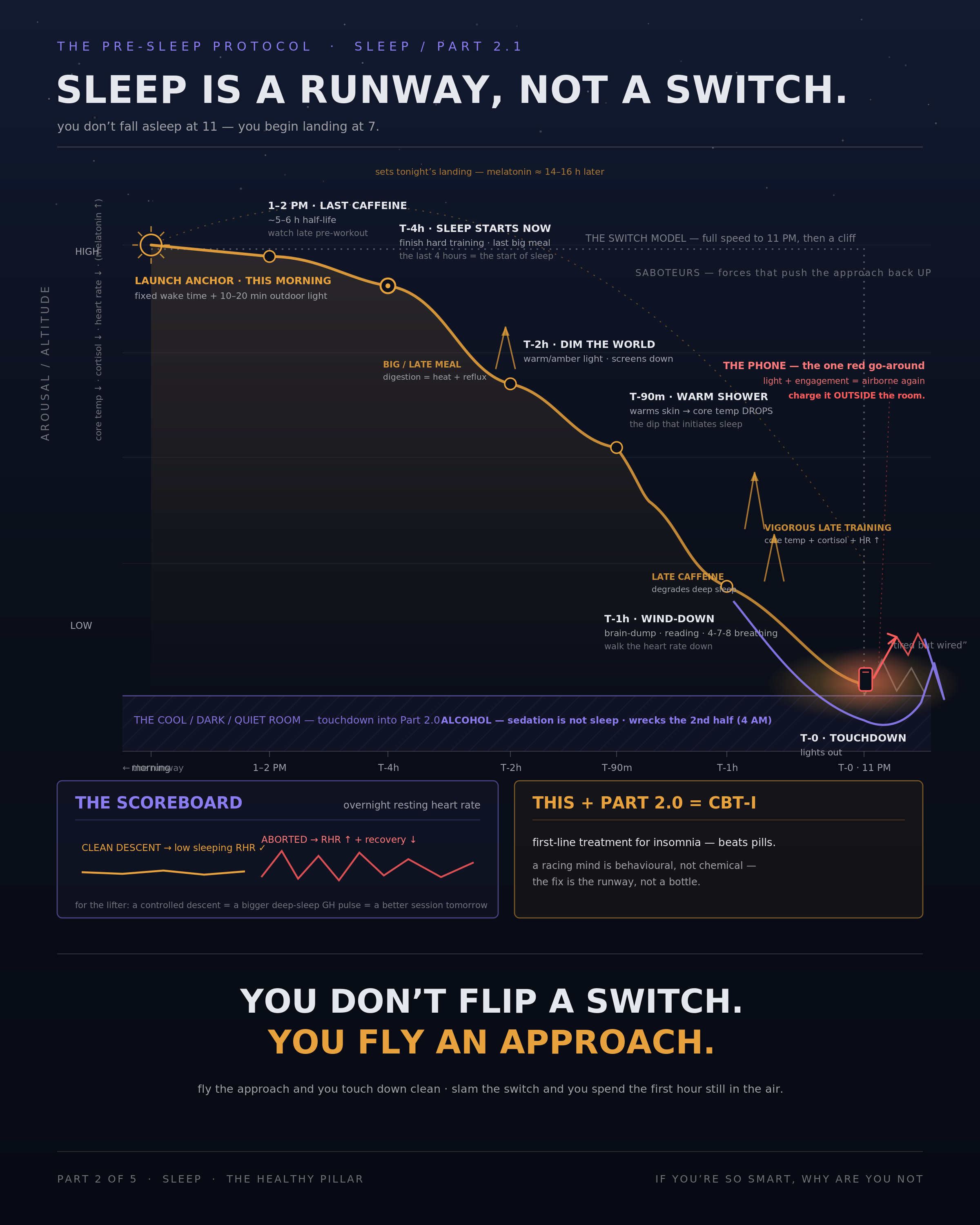
Here’s the whole evening as a single descent profile: sleep isn’t a switch you flip at 11 — it’s a four-hour glide-path you fly down, each habit a waypoint that steps your core temperature, cortisol, and heart rate lower until you touch down. The poster lays the good approach against the failing “switch model,” marks the morning launch anchor that quietly sets tonight’s landing, flags alcohol as the deceiver that fakes a fast descent then breaks the second half, and reserves its one red for the phone go-around. Pin it up: you don’t flip a switch, you fly an approach.
Part 2.1 Takeaways
Key concepts to internalize
- Sleep is a runway, not a switch. The last ~4 hours are the start of sleep; you have to descend, not slam the brakes at 11 PM.
- The master control is your morning, not your night: a fixed wake time (7 days a week) plus bright morning light sets tonight’s sleep. Pair with the dark evening from Part 2.0.
- Caffeine has a ~5–6 h half-life and degrades deep sleep even when you “sleep fine” — cut it ~8–10 h before bed; watch late pre-workout.
- Alcohol sedates then sabotages — it suppresses REM and fragments the second half. Sedation is not sleep.
- Finish the last big meal ~2–3 h out; fix the late-workout/9 PM-meal stack so digestion and training don’t both invade the runway.
- Exercise helps sleep; only vigorous work in the last hour hurts it. Use overnight RHR as your scoreboard and build a deliberate descent after late sessions.
- Dim the world after sunset; take a warm shower ~90 min out (it drops core temp); down-regulate a racing mind with a brain-dump and slow, long-exhale breathing.
- The behavioural toolkit here + Part 2.0 is CBT-I — the first-line treatment for insomnia. Exhaust it before Part 3.
Your Protocol Task List
- Set one fixed wake time for all 7 days and get 10–20 minutes of outdoor light within an hour of it. This is the highest-leverage habit — start here.
- Set a caffeine cutoff (~1–2 PM for an 11 PM bed) and hold it for two weeks. Kill late pre-workout.
- Define your “T-4h” line. Decide the clock time your sleep “starts,” and protect the runway after it — no intense training, no big meals, no work creeping in.
- Install a warm shower ~90 minutes before bed and a screen-free last 30–60 minutes.
- Build a fixed wind-down sequence (same order nightly) ending with slow breathing; keep a paper notebook for the brain-dump.
- Audit alcohol and late meals against any 3–4 AM wake-ups.
- Cut naps until your nights are solid; if you must, ≤25 min before 3 PM.
Up next
Disclaimer
This article is educational and not medical advice. Chronic insomnia, sleep that stays broken despite a solid environment and routine, or sleep problems alongside anxiety or depression should be assessed by a qualified professional — CBT-I is the recommended first-line treatment and is more effective long-term than sleeping pills. Repeated 3–4 AM awakenings with snoring or gasping can indicate sleep apnoea and warrant medical evaluation.
Sources & references
Footnotes
-
Drake, C. et al. (2013), “Caffeine effects on sleep taken 0, 3, or 6 hours before going to bed,” Journal of Clinical Sleep Medicine 9(11):1195–1200 — 400 mg of caffeine taken even 6 hours before bedtime significantly reduced total sleep time, with participants frequently underestimating the disruption. Caffeine’s elimination half-life is approximately 5–6 hours in healthy adults. ↩
-
Ebrahim, I.O. et al. (2013), “Alcohol and sleep I: effects on normal sleep,” Alcoholism: Clinical and Experimental Research 37(4):539–549 — alcohol reduces sleep-onset latency and increases early-night slow-wave sleep but suppresses REM and fragments the second half of the night, producing non-restorative sleep. ↩
-
Stutz, J., Eiholzer, R. & Spengler, C.M. (2019), “Effects of Evening Exercise on Sleep in Healthy Participants: A Systematic Review and Meta-Analysis,” Sports Medicine 49(2):269–287 — evening exercise generally does not impair, and can improve, sleep; the exception is vigorous exercise ending within ~1 hour of bedtime, which can delay sleep onset and elevate heart rate. ↩
-
Haghayegh, S. et al. (2019), “Before-bedtime passive body heating by warm shower or bath to improve sleep: A systematic review and meta-analysis,” Sleep Medicine Reviews 46:124–135 — warm water immersion (~40–42 °C) roughly 1–2 hours before bed shortened sleep-onset latency and improved sleep quality, via accelerated distal heat loss and core-temperature decline. ↩