This is Part 2 of 5 in the Sleep Series — the first and most passive lever: build the room so it does the work for you. The full path:
- Part 1: The Architecture of Sleep — what sleep is and what it’s for
- Part 2 — The Setup (2 sub-articles):
- Part 2.0 (this article): The Environment — building the room that does the work for you
- Part 2.1: The Pre-Sleep Protocol — the last four hours are the start of sleep
- Part 3 — Pharmacology (2 sub-articles):
- Part 3.0: Natural & OTC Support — the supplement layer, only after the basics
- Part 3.1: The Pharmacological Reset — DORAs, trazodone, and the 30-day rebuild
Table of Contents
- Why the environment comes before everything
- The four pillars of a sleep room
- Pillar 1 — Cold
- Pillar 2 — Dark
- Pillar 3 — Quiet
- Pillar 4 — Reserved: the bed is for sleep only
- Air: the pillar everyone forgets
- The bed itself
- The phone
- The setup checklist
- Part 2.0 Takeaways
- Your Environment Task List
- Sources & references
The highest return on the least ongoing effort
Of everything in this series, the environment is the lever with the best effort-to-payoff ratio, because it’s passive. You fix the room once and it then improves every single night with zero willpower required forever. Behaviour (Part 2.1) takes nightly discipline; pharmacology (Part 3) carries cost and risk. The room just works. Spend your first effort here.
Why the environment comes before everything
Recall the core fact from Part 1.0: you don’t take sleep, you build the conditions under which your nervous system allows it. The bedroom is where those conditions physically live. And recall the second fact — most of the damage to your sleep architecture comes not from failing to fall asleep, but from arousals you never consciously remember: a degree too warm, a sliver of streetlight, a truck downshifting outside, a notification’s glow. Each one can bump you out of deep sleep or REM and force you to climb back down.
The entire job of the environment is to remove those arousals before they happen. You are engineering a space that signals safe, dark, cool, quiet to a nervous system that evolved to stay alert to exactly the opposite. Get this right and you’ll often find half your “sleep problem” was an environment problem.
The Malaysian reality, stated up front
Most sleep advice is written for temperate climates and quiet suburbs. Living in Malaysia you’re fighting heat, humidity, mosquitoes, and often a noisy, bright urban environment — KL traffic, neighbours, surau/azan, condos with thin walls. That makes the environment work more important here, not less, and a couple of the fixes (aircon strategy, dehumidifying, sound masking) are non-negotiable rather than nice-to-have. I’ll flag the tropical specifics as we go.
The four pillars of a sleep room
Everything reduces to four properties. In rough order of impact:
| Pillar | The target | Why it matters | The cheap fix |
|---|---|---|---|
| Cold | ~18–20 °C ambient | Sleep onset requires a core-temperature drop; a warm room blocks it | Aircon + breathable bedding |
| Dark | As close to pitch black as possible | Light is the master circadian signal; even dim light suppresses melatonin and lightens sleep | Blackout curtains + eye mask + kill LEDs |
| Quiet | Consistent, low, or masked sound | Noise causes micro-arousals even when you don’t wake | Earplugs and/or a fan / white-noise |
| Reserved | Bed = sleep (and sex) only | Conditions your brain to associate the bed with sleep, not wakefulness | Stimulus control: no work, no scrolling in bed |
Pillar 1 — Cold
This is the one people underrate the most, and in the tropics it’s the one that matters most.
The mechanism: your core body temperature has to drop by roughly 1 °C to initiate and maintain sleep, and it naturally falls across the night, bottoming out a couple of hours before you wake.1 A warm room physically obstructs that drop, which is why a hot bedroom causes both trouble falling asleep and fragmented, shallow sleep — your body keeps trying to dump heat it can’t shed. The research consistently lands on an ideal ambient bedroom temperature of around 18–20 °C (≈65–68 °F) for most people.
The counter-intuitive part: warm extremities, cool core
Your body initiates sleep by dilating the blood vessels in your hands and feet to radiate core heat out (distal vasodilation). This is why warm feet help you fall asleep faster even though you want the room cold — warm socks or a hot-water bottle at the feet open those vessels and accelerate core cooling. Cold room, warm feet. It sounds contradictory; it isn’t.
The tropical playbook:
- Aircon is the primary tool, not a luxury. Set it to ~20–22 °C. (You’ll rarely hit a true 18 °C in a humid room without it feeling clammy; aim for comfortably cool to slightly cold under a light blanket.) If you run it all night, a timer that lets the room warm slightly toward your wake time can help — but for most people in KL heat, steady cool wins.
- Humidity is half the battle. High humidity blocks evaporative cooling (sweat can’t evaporate), so a “warm” tropical night feels far worse than the same temperature dry. Aircon dehumidifies as it cools; a dehumidifier or the aircon’s “dry” mode helps further. Target ~40–60% relative humidity.
- Bedding must be breathable. Cotton or linen over polyester; a light blanket you can kick off. The aim is to be cool but covered — the weight of a light blanket is calming, but you don’t want to trap heat.
- A fan earns its place twice: it moves air for cooling and provides consistent masking sound (Pillar 3). A ceiling fan plus aircon is a classic Malaysian combination for a reason.
- Cooling mattress/pillow materials (gel, latex over memory foam) help if you sleep hot, since memory foam notoriously traps heat.
The aircon-versus-fresh-air tension
Sealing the room and running aircon all night solves heat but can create the air-quality problem we cover below (rising CO₂). The fix isn’t to suffer the heat — it’s to ventilate deliberately at other times and, if possible, allow a small amount of air exchange. Don’t trade a cool room for a stuffy one; you need both.
Pillar 2 — Dark
After temperature, light is the single most powerful environmental signal — because it’s the primary input to the circadian clock from Part 1.0. Light tells your brain it’s daytime, suppresses melatonin (the hormone that signals “night”), and pushes your clock later.
The evidence is blunt: exposure to ordinary room light in the hours before bed suppresses melatonin and delays its onset, and light during sleep — even modest levels — lightens sleep, raises overnight heart rate, and worsens next-day insulin resistance.2 Your eyelids are not blackout curtains; light still registers through them.
The fixes, cheapest to most thorough:
- Kill the little lights. The standby LEDs on the TV, router, aircon unit, phone charger, power strip — tape over them or unplug them. A single blue pinpoint LED is brighter at 3 AM than you think.
- Block the window. Blackout curtains or blinds. In an apartment with streetlights or an early tropical sunrise (~7 AM year-round near the equator), this is essential. Cheap blackout liners behind existing curtains work.
- A good eye mask is the highest-leverage RM30 you’ll spend. It guarantees darkness regardless of the room, travels with you, and a well-shaped one (cupped, no eye pressure) is worth paying for over a flat one.
- Phone face-down or out of the room (see The phone).
- If you need a night-light (stairs, a child, getting to the bathroom), use dim, warm/red light, low to the ground. Red and amber wavelengths suppress melatonin far less than blue/white. Never flip on a bright white bathroom light at 3 AM — it can fully reset your clock and end your night.
Darkness at night, light in the morning — the same lever, both ends
The flip side of blocking light at night is flooding your eyes with bright light first thing in the morning, which anchors your clock and builds healthy sleep pressure for that night. That’s a behaviour, so it lives in Part 2.1 — but know now that “dark room” and “morning sunlight” are two halves of one circadian strategy.
Pillar 3 — Quiet
Noise is the classic arousal generator. The problem isn’t only the sounds that wake you fully — it’s the ones that cause micro-arousals, brief shifts to lighter sleep that you won’t remember but that fragment your architecture and rob you of deep and REM sleep. Your brain monitors sound for threat even while you’re unconscious; a sudden, variable, meaningful sound (a notification, a car alarm, a voice) is far more disruptive than a steady, featureless one at the same volume.
That last point is the key to the solution: consistency beats silence. True silence is rare and, paradoxically, makes every random noise more jarring by contrast. So you have two strategies, and most people use both:
- Block: earplugs (foam, or moldable silicone; soft silicone is more comfortable for side-sleepers). The best ~RM5–40 you can spend if your environment is noisy.
- Mask: a constant, broadband sound that fills in the gaps so intrusions don’t stand out — a fan, an aircon’s hum, or white/brown noise (brown noise is lower-pitched and many find it less harsh). The fan does double duty with cooling.
Tropical/urban specifics: if you’re near a main road, a mosque, a construction site, or thin-walled neighbours, masking is essentially mandatory. A fan running all night is the simplest fix. For a snoring partner, earplugs plus a fan; if the snoring is loud, irregular, and punctuated by silences and gasps, that partner may have sleep apnoea and should see a doctor — it’s both a disruptor for you and a serious health issue for them.
Pillar 4 — Reserved: the bed is for sleep only
This is the most behavioural of the environment pillars, and it’s the cornerstone of CBT-I (cognitive behavioural therapy for insomnia — the actual first-line, evidence-based treatment for chronic insomnia, ahead of any drug). The technique is called stimulus control, and the principle is simple:3
==Your brain is an association machine. Whatever you repeatedly do in bed becomes what the bed means to your nervous system.==
If you work, scroll, worry, watch TV, eat, and answer emails in bed, you train your brain that the bed is a place for alertness — and then it dutifully keeps you alert when you lie down. If the bed is used only for sleep (and sex), lying down becomes a powerful, conditioned trigger for sleep. People with insomnia have often, without realising it, conditioned their bed into a cue for anxious wakefulness.
The rules:
- The bed is for sleep and sex. Nothing else. No laptop, no work, no doom-scrolling, no TV in bed.
- No clock-watching. Turn the clock away. Calculating “if I sleep now I’ll get 5 hours 12 minutes” is pure arousal and self-fulfilling.
- The 20-minute rule: if you’ve been lying awake for ~20 minutes (estimated — don’t watch the clock) and you’re wired, get up, go to another room, do something boring and dimly lit, and return only when sleepy. This is counter-intuitive but vital: lying in bed frustrated strengthens the bed–wakefulness association you’re trying to break. Protect the cue.
The work-from-home trap (Nadeem's "isolate the workplace")
The modern killer of stimulus control is working where you sleep. If your laptop lives on your bed and you take calls under the covers, your bedroom is now your office, and your brain can’t tell the two states apart. Separate the workspace from the sleep space. Ideally that means a different room. If you live in a studio or a single room and can’t, then at minimum create hard boundaries: work at a desk (never the bed), pack the laptop away at a set time, and physically reconfigure the space for night — a literal “closing the office” ritual. The bed must not be a workstation, even in 400 square feet.
Why this is a Part 2 problem and not a Part 3 problem
A huge fraction of “I can’t sleep” is conditioned, not chemical. People reach for melatonin or a Z-drug for a problem that stimulus control alone fixes. ==If your bed has become a place where you think and worry rather than sleep, no pill reliably out-runs that association — but six weeks of strict stimulus control can rebuild it.== This is also exactly the foundation the Part 3.1 reset is designed to bootstrap.
Air: the pillar everyone forgets
Most sleep guides stop at cold/dark/quiet. But bedroom air quality has measurable effects on sleep depth and next-day performance, and it’s the hidden cost of the sealed-aircon room.4
- CO₂ buildup. A closed bedroom with one or two sleepers and no ventilation sees CO₂ climb through the night, and elevated CO₂ is associated with lighter, less restful sleep and worse next-day cognition. Cracking a door or window, or allowing some air exchange, helps — the tension with aircon and noise is real, so balance it (e.g., a slightly open internal door, or ventilating hard before bed).
- Humidity (covered under Cold) also affects comfort and the growth of dust mites and mould — both common allergens in the tropics.
- Allergens and dust. Blocked nasal breathing fragments sleep and pushes you toward mouth-breathing and snoring. Wash bedding regularly in hot water, consider an allergen-proof mattress/pillow cover, and if you have allergies or are in a dusty/humid flat, an air purifier (HEPA) is a worthwhile addition. Keep pets off the bed if you’re sensitive.
The bed itself
Don’t turn this into a religion or a spending spree, but the basics matter because you’re on it for a third of your life:
- Mattress: supportive enough to keep your spine neutral, comfortable enough that you’re not waking from pressure points. “Best mattress” is individual — firmness preference and sleeping position drive it more than price. If you sleep hot (likely, in the tropics), avoid dense memory foam that traps heat; latex, hybrid, or gel-infused options sleep cooler.
- Pillow: match it to your sleep position — side sleepers need a thicker/firmer pillow to fill the shoulder gap and keep the neck neutral; back sleepers need a thinner one; stomach sleeping strains the neck and is best avoided. A neck that’s bent all night causes the morning stiffness people blame on “sleeping wrong.”
- Replace what’s broken. A sagging mattress or a flat, lumpy pillow causes pain that fragments sleep. This is one place the spend is justified.
The phone
The phone deserves its own section because it’s the single most destructive object in the modern bedroom, and it attacks three pillars at once: it’s a light source (bright, blue-rich, right at your eyes), a noise/arousal source (notifications, vibration), and the ultimate stimulus-control violation (scrolling in bed trains the bed for alertness, and the content itself — news, social media, messages — is engineered to keep you engaged and emotionally activated exactly when you need to wind down).
The one rule that beats every "night mode" feature
Charge your phone outside the bedroom. Not face-down on the nightstand — outside the room. Night-mode/blue-light filters help a little with the light, but they do nothing about the engagement and the conditioning, which are the bigger problems. Buy a RM15 alarm clock so “I use it as my alarm” stops being the excuse. If the phone must be in the room, it goes across the room, face down, on Do Not Disturb. The reflex to “just check one thing” is the enemy; the only reliable defence is distance.
The setup checklist
A one-time audit. Walk into your bedroom tonight and run it:
| Pillar | Check | Fix if failing |
|---|---|---|
| Cold | Is it ≤~22 °C and not humid/clammy? | Aircon ~20–22 °C; dehumidify; breathable bedding; warm socks |
| Dark | Can you see your hand in front of your face after 5 min? | Blackout curtains; eye mask; tape/kill all LEDs; phone out |
| Quiet | Any sudden/variable noises intrude? | Earplugs; fan or white/brown noise to mask |
| Reserved | Do you work, scroll, or watch TV in bed? | Bed = sleep + sex only; move the desk; 20-minute rule |
| Air | Is the room stuffy by morning? | Ventilate before bed / crack a door; HEPA purifier if dusty |
| Bed | Wake with neck/back pain or pressure points? | Right pillow for your position; replace a sagging mattress |
| Phone | Is it within arm’s reach of the pillow? | Charge it outside the room; buy a dumb alarm clock |
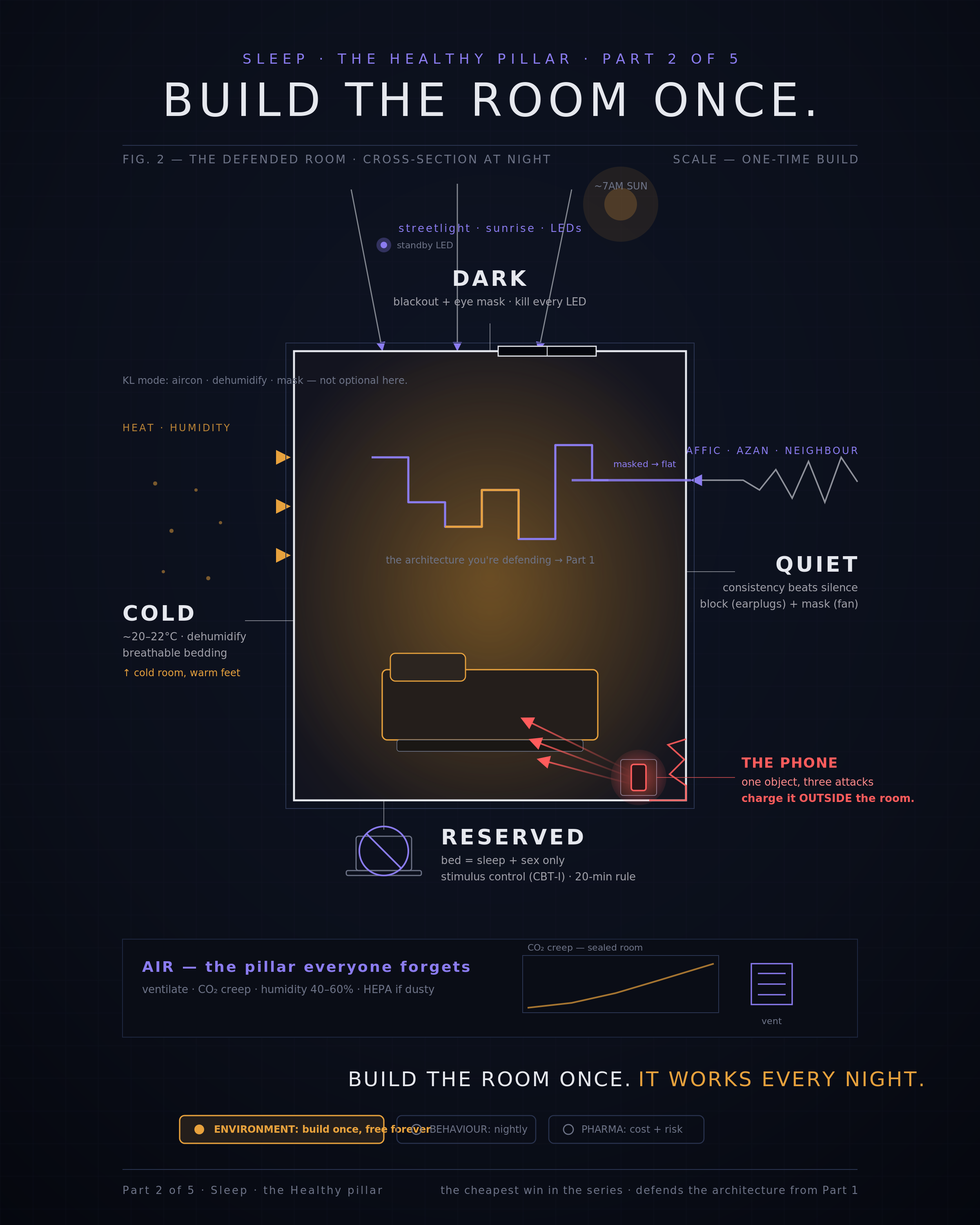
Here’s the whole room in a single picture: your bedroom drawn as a defensive machine you build once, which then intercepts heat, light, noise, and intrusion every night while you sleep defenceless inside it. The four walls are the four pillars — Cold · Dark · Quiet · Reserved — each stopping its matching incoming threat, with Air as the forgotten foundation beneath and the phone as the one red breach you leave open in an otherwise sealed wall. Pin it up: build the room once, and it works every night.
Part 2.0 Takeaways
Key concepts to internalize
- Environment is the highest-leverage, lowest-effort lever — fix it once, benefit every night, no willpower required. Do this first.
- Its job is removing arousals you’d never consciously notice but that fragment the architecture from Part 1.0.
- Four pillars: Cold, Dark, Quiet, Reserved. Cold (~18–20 °C, core temp must drop — but warm feet help); Dark (light is the master clock signal; kill every LED, blackout + eye mask); Quiet (consistency beats silence — block with earplugs, mask with a fan); Reserved (bed = sleep + sex only — stimulus control, the CBT-I cornerstone).
- Air is the forgotten pillar — sealed aircon rooms accumulate CO₂; ventilate and manage humidity/allergens.
- The phone is the worst object in the room — light, noise, and conditioning in one device. Charge it outside the bedroom.
- Tropical reality: aircon, dehumidifying, and sound-masking aren’t optional luxuries here — they’re the core of the setup.
Your Environment Task List
- Run the setup checklist above tonight, room by room. Write down every “failing” cell.
- Buy the cheap wins this week: an eye mask, earplugs, and a basic alarm clock (so the phone can leave). Under RM100 total, biggest single-night impact of anything in this series.
- Dial in the aircon: set ~20–22 °C, manage humidity (dry mode / dehumidifier), switch to breathable bedding.
- Black out the room: blackout curtains or liner, and tape/unplug every standby LED you can find.
- Enforce “bed = sleep only” for two weeks, including the 20-minute get-up rule — and if you work from home, physically separate the workspace from the sleep space.
- Move the phone charger out of the bedroom tonight. Just try one week.
Up next
The room is now passively working for you 24/7. Part 2.1 — The Pre-Sleep Protocol adds the behavioural layer: the idea that the last four hours of your day are already the start of sleep, and exactly what to do (and stop doing) in that window — light, caffeine, food, training, and winding the nervous system down.
Disclaimer
This article is educational and not medical advice. Loud snoring with gasping or pauses in breathing, choking awake, or severe daytime sleepiness can indicate obstructive sleep apnoea, which a cooler/quieter room will not fix and which carries serious cardiovascular risk — see a doctor for evaluation. Persistent insomnia despite a good environment also warrants professional assessment (CBT-I is the recommended first-line treatment).
Sources & references
Footnotes
-
Okamoto-Mizuno, K. & Mizuno, K. (2012), “Effects of thermal environment on sleep and circadian rhythm,” Journal of Physiological Anthropology 31:14 — review of how ambient temperature and the sleep-onset drop in core body temperature interact; heat exposure increases wakefulness and reduces slow-wave and REM sleep. The distal-vasodilation/heat-loss mechanism is reviewed in Kräuchi et al. (1999), Nature 401:36–37, “Warm feet promote the rapid onset of sleep.” ↩
-
Gooley, J.J. et al. (2011), “Exposure to room light before bedtime suppresses melatonin onset and shortens melatonin duration in humans,” Journal of Clinical Endocrinology & Metabolism 96(3):E463–E472. On light during sleep: Mason, I.C. et al. (2022), PNAS 119(12), “Light exposure during sleep impairs cardiometabolic function” — even moderate room light raised overnight heart rate and next-morning insulin resistance. ↩
-
Stimulus control therapy originates with Bootzin (1972) and is a core component of CBT-I, which the American Academy of Sleep Medicine and American College of Physicians recommend as first-line treatment for chronic insomnia, ahead of pharmacotherapy. See Qaseem, A. et al. (2016), “Management of Chronic Insomnia Disorder in Adults: A Clinical Practice Guideline From the American College of Physicians,” Annals of Internal Medicine 165(2):125–133. ↩
-
Strøm-Tejsen, P. et al. (2016), “The effects of bedroom air quality on sleep and next-day performance,” Indoor Air 26(5):679–686 — improved bedroom ventilation (lower CO₂) was associated with better sleep quality and next-day performance. ↩