This is Part 3 of 4 in the Fitness Series. The full path:
- Part 1 - The Goal (2 sub-articles):
- Part 2: Structure of a Day - the daily framework
- Part 3 - The Program (3 sub-articles):
- Part 3.1: Concepts - the conceptual foundation
- Part 3.2: Rules and Building the Program - contexts
- Part 3.3 (this article): Example Programs - practicalities
- Part 4: Pharmacology - supplements and beyond
Table of Contents
- How to use these programs
- Template 1: Anterior / Posterior — 4 days per week
- Template 2: Full Body Every Other Day (FBEOD) — 3–4 days per week
- The progression cycle inside the split
- How to adapt these programs to you
- Part 3.3 Takeaways
- Your First-Mesocycle Task List
- Sources & references
How to use these programs
Part 3.1 covered the concepts. Part 3.2 covered the rules and the building blocks. This article gives two concrete templates that can be run as-is, or adapted using the principles already established.
Before starting either template The rules from Part 3.2 all apply:
- Every working set: 8–12 reps, controlled tempo, last set to failure or 0–1 RIR
- 3 minutes rest between working sets, always
- Double progression: add reps within the range, then add weight when the top of the range is hit
- No static stretching before; cascade up to working weight on the first exercise of each muscle group
- Track every set in Hevy or equivalent
- Form check videos every 4–6 weeks
- Run the program for at least 8–12 weeks before judging whether it’s working
The two templates differ in frequency and structure, not in goal. Both produce hypertrophy. Choose based on schedule, recovery capacity, and personal preference not because one is “better.”
Template 1: Anterior / Posterior — 4 days per week
This is the workhorse split for transformation work. Four sessions per week, ~75 minutes each. Each muscle gets hit twice a week, hitting the Schoenfeld 2016 frequency rule cleanly. The anterior/posterior division respects how the body actually moves, front-of-body muscles work in opposition to back-of-body muscles, so pairing them across alternating days gives 48 hours of recovery per region.
Weekly structure
| Day | Session |
|---|---|
| Monday | Day A — Anterior |
| Tuesday | Day B — Posterior |
| Wednesday | Rest |
| Thursday | Day C — Anterior (variation) |
| Friday | Day D — Posterior (variation) |
| Saturday | Rest |
| Sunday | Rest |
Rest day notes The Wednesday and weekend rest days are non-negotiable for recovery. Don't add cardio at high intensity on those days — light walking is fine and aligns with Rule 2 from Part 2 (insulin activation through movement).
Day A — Anterior
Quad-dominant lower body, vertical pulling, vertical pushing, biceps.
| # | Exercise | Pattern | Sets × Reps |
|---|---|---|---|
| 1 | Calf Raise | Plantar flexion | 3 × 10–12 |
| 2 | Leg Extension | Knee extension (quad) | 3 × 8–10 |
| 3 | Hack Squat (or Pendulum Squat) | Vertical squat, quad bias | 3 × 8–10 |
| 4 | Lat Pulldown | Vertical pulling | 3 × 8–10 |
| 5 | Machine Shoulder Press | Vertical pushing | 3 × 8–10 |
| 6 | Hammer Curl | Elbow flexion (brachialis) | 2 × 10–12 |
| 7 | Lateral Raise | Shoulder abduction (side delt) | 2 × 10–12 |
Total working sets: ~19. Within reasonable MRV territory for most lifters.
Notes on Day A
- Hack Squat with a closed stance emphasizes quads and calves.
- Machine Shoulder Press is the starting variation; can rotate to Seated Dumbbell Press, then Standing OHP across mesocycles (see progression cycle below).
- Lateral Raise is the most under-loaded exercise in most programs — don’t be afraid to keep this in the 10–12 range and prioritize controlled form over weight.
Day B — Posterior
Hamstring/glute hip-hinge, horizontal pushing, horizontal pulling, rear delt.
| # | Exercise | Pattern | Sets × Reps |
|---|---|---|---|
| 1 | Calf Raise | Plantar flexion | 3 × 10–12 |
| 2 | Dumbbell RDL (or Barbell RDL) | Hip hinge | 3 × 8–10 |
| 3 | Seated Leg Curl | Knee flexion (hamstring) | 3 × 8–10 |
| 4 | Chest Press (Machine or Barbell Bench) | Horizontal pushing | 3 × 8–10 |
| 5 | Seated Cable Row (or Chest-Supported Row) | Horizontal pulling | 3 × 8–10 |
| 6 | Kelso Shrug | Scapular retraction (mid traps) | 2 × 10–12 |
| 7 | Incline Chest Fly (or Pec Deck) | Horizontal adduction (chest) | 2 × 10–12 |
Total working sets: ~19.
Notes on Day B
- RDL targets the hamstrings via the hip hinge; the strict eccentric is what produces the stimulus, not the load. Don’t sacrifice form for weight.
- Kelso Shrug isolates the mid traps without recruiting rear delts (unlike a face pull) — useful for biasing scapular retraction.
- Incline Fly hits the upper chest at a different angle than the press, providing the stretch-loaded variation that pressing alone misses.
Day C — Anterior (variation)
Same patterns as Day A, with exercise variations to provide novel stimulus and avoid pure repetition.
| # | Exercise | Pattern | Sets × Reps |
|---|---|---|---|
| 1 | Calf Raise | Plantar flexion | 3 × 10–12 |
| 2 | Leg Extension | Knee extension (quad) | 3 × 8–10 |
| 3 | Bulgarian Split Squat | Unilateral quad-dominant | 3 × 8–10 per leg |
| 4 | Pull-Up (or Weighted Pull-Up) | Vertical pulling | 3 × 6–10 |
| 5 | Seated Dumbbell Press | Vertical pushing | 3 × 8–10 |
| 6 | Hammer Curl | Elbow flexion (brachialis) | 2 × 10–12 |
| 7 | Y-Raise (Seated 45°) | Posterior shoulder elevation | 2 × 10–12 |
Notes on Day C
- Bulgarian Split Squat is a brutal unilateral movement that exposes left/right strength imbalances and biases the quads heavily. Don’t go too heavy — controlled form on each leg matters more than load.
- Pull-Up is the upgraded version of Pulldown. If unable to hit 6 clean reps yet, stay on Pulldown and progress until bodyweight pull-ups become possible.
- Y-Raise hits the rear delts and posterior shoulder in a way that lateral raise doesn’t — pair it with Lateral Raise in the program rotation, not in the same session.
Day D — Posterior (variation)
Same patterns as Day B, with hamstring-biased squat and exercise variations.
| # | Exercise | Pattern | Sets × Reps |
|---|---|---|---|
| 1 | Calf Raise | Plantar flexion | 3 × 10–12 |
| 2 | Hack Squat (hamstring-biased stance) | Squat with glute/hamstring bias | 3 × 8–10 |
| 3 | Seated Leg Curl | Knee flexion (hamstring) | 3 × 8–10 |
| 4 | Incline Chest Press | Horizontal/upper-chest pushing | 3 × 8–10 |
| 5 | Iso-Lateral High Row | Horizontal pulling, upper back | 3 × 8–10 per side |
| 6 | Kelso Shrug | Scapular retraction | 2 × 10–12 |
| 7 | Back Extension (or Weighted Back Extension) | Spinal extension | 2 × 10–12 |
Notes on Day D
- Hack Squat with feet placed higher and wider biases the glutes and hamstrings (the same exercise as Day A, different stance — different muscle bias). This is a clean example of the biasing concept from Part 3.1.
- Incline Chest Press hits the upper chest fibers more than flat bench, balancing out the press work across the week.
- Iso-Lateral High Row exposes left/right imbalance and targets the upper back at a steeper angle than seated row.
Notes on the AP split
Why this works Each muscle gets two sessions per week. The first session is the "primary" version (Days A and B), the second is the "variation" with slightly different exercise selection (Days C and D). This keeps frequency at 2× per muscle while introducing enough exercise variety to hit different angles and motor patterns — without abandoning the core movements that drive progressive overload.
Volume math (per muscle per week):
- Quads — ~6 direct sets (Leg Extension ×2, plus 6 sets of squat variations) = ~12 effective sets
- Hamstrings — ~6 direct sets (Leg Curl ×2, plus indirect from RDL and back extension)
- Chest — ~6 direct sets (Chest Press, Incline Press, Fly)
- Back — ~6 direct sets across pulldown/pull-up, row variations
- Shoulders — ~5 sets across pressing and lateral/Y-raise
- Arms — ~4 direct sets, plus heavy indirect contribution from press and pull movements
This lands in the 12–18 sets/muscle/week range that fits MAV-to-MRV territory for most intermediate lifters (see MRV in Part 3.1).
When to use AP split Best for intermediate lifters with 1+ years of training, training 4 days a week, and wanting a clean separation between front-body and back-body work. Easier to recover from than push/pull/legs because no muscle group gets hit on consecutive days.
Template 2: Full Body Every Other Day (FBEOD) — 3–4 days per week
The alternative split. Each session hits the full body, with rotating emphasis between days. Frequency per muscle climbs to 3× per week instead of 2×. Sessions can be slightly shorter because volume is distributed across more days.
Weekly structure
| Day | Session |
|---|---|
| Monday | Full-Body Day 1 — Quad-dominant |
| Tuesday | Rest |
| Wednesday | Full-Body Day 2 — Hip-hinge-dominant |
| Thursday | Rest |
| Friday | Full-Body Day 3 — Mixed |
| Saturday | Rest |
| Sunday | Rest |
This is a 3-day version. A 4-day version inserts an extra full-body day on Saturday with whatever lagging muscle group needs additional volume.
Full-Body Day 1 — Quad-dominant
| # | Exercise | Pattern | Sets × Reps |
|---|---|---|---|
| 1 | Hack Squat | Quad-dominant squat | 3 × 8–10 |
| 2 | Leg Curl | Knee flexion (hamstring) | 2 × 10–12 |
| 3 | Bench Press (or Machine Press) | Horizontal pushing | 3 × 8–10 |
| 4 | Lat Pulldown | Vertical pulling | 3 × 8–10 |
| 5 | Lateral Raise | Shoulder abduction | 2 × 10–12 |
| 6 | Hammer Curl | Elbow flexion | 2 × 10–12 |
Total working sets: ~15. Session time ~60–70 minutes.
Full-Body Day 2 — Hip-hinge-dominant
| # | Exercise | Pattern | Sets × Reps |
|---|---|---|---|
| 1 | RDL | Hip hinge | 3 × 8–10 |
| 2 | Leg Extension | Quad | 2 × 10–12 |
| 3 | Overhead Press | Vertical pushing | 3 × 8–10 |
| 4 | Seated Cable Row | Horizontal pulling | 3 × 8–10 |
| 5 | Y-Raise / Rear Delt Fly | Posterior shoulder | 2 × 10–12 |
| 6 | Triceps Pushdown | Elbow extension | 2 × 10–12 |
Full-Body Day 3 — Mixed
| # | Exercise | Pattern | Sets × Reps |
|---|---|---|---|
| 1 | Bulgarian Split Squat | Unilateral quad | 2 × 8–10 per leg |
| 2 | Back Extension | Posterior chain | 2 × 10–12 |
| 3 | Incline Chest Press | Upper chest | 3 × 8–10 |
| 4 | Pull-Up | Vertical pull | 3 × 6–10 |
| 5 | Lateral Raise | Side delt | 2 × 10–12 |
| 6 | Calf Raise | Plantar flexion | 3 × 10–12 |
Notes on FBEOD
Why this works for naturals Spreading total volume across three sessions means each muscle is hit more frequently with less per-session damage. Muscle protein synthesis stays elevated more consistently across the week, which can translate to better growth in some lifters — particularly those with good recovery capacity. 1
Volume math (per muscle per week):
- Quads — Hack Squat (3) + Leg Extension (2) + Bulgarian (2) = ~7 direct sets, plus indirect from hip hinge work
- Hamstrings — RDL (3) + Leg Curl (2) + Back Ext (2) = 7 direct
- Chest — Bench Press (3) + Incline Press (3) = 6 direct
- Back — Pulldown (3) + Row (3) + Pull-Up (3) = 9 direct
- Shoulders — OHP (3) + Lateral (2 sessions × 2 sets) + Y-Raise (2) = ~9
- Arms — Hammer (2) + Triceps Pushdown (2) = 4 direct, plus heavy indirect from press/pull
Total volume per muscle is similar to AP split, just distributed differently.
When to use FBEOD Better for lifters with limited time per session (60-minute sessions instead of 75), good recovery capacity, and a preference for more frequent training. Also useful for naturals coming off a long break — the higher frequency drives faster neural relearning.
When to avoid If recovery is compromised (poor sleep, high life stress, low calories during a cut), AP split is gentler. FBEOD demands more from the recovery system because back-to-back sessions hit overlapping muscles.
How to Progress Each Week
Your goal with this program is to improve in some way every session while maintaining proper form. Progression should happen through one of the following:
- Increase weight: If you reach the top of the prescribed rep range with good form, increase the weight slightly in the next session. You should aim to add 1.25kg/2.5lbs every week until reps fall below the prescribed range
- Increase reps: If increasing weight is not yet possible, add more reps while staying within the prescribed rep range.
- Improve form, control, and range of motion: Ensure you are executing each rep properly before focusing on adding weight. Pay attention to tempo, pauses, depth, and positioning.
Example: If an exercise has a target rep range of 8-12 reps and you complete 10 reps at 40kg, aim for 11 or 12 reps next session. Once you reach 12 reps with good form, increase the weight slightly and work back up.
The progression cycle inside the split
Whichever template is run, individual exercises should rotate between phases over months. ==This rotation is a specific instance of the Variation Cycle from Part 3.2== — the templates below pre-build a sensible rotation so it can be run without designing it from scratch.
- Isolation/machine phase — establish the movement pattern, drive the muscle directly, double-progress for 4–8 weeks until it stalls.
- Compound/free-weight phase — switch the slot to its compound counterpart (Lat Pulldown → Pull-Up; Machine Shoulder Press → Standing OHP). The new movement resets the neural adaptation curve and expands the strength ceiling because stabilizers are now being trained too.
- Return to isolation — when returning to the original isolation, the lifter is stronger than when they left. The cycle repeats with a new ceiling.
Progression chain for the vertical pushing slot
- Mesocycle 1 (weeks 1–8) — Machine Shoulder Press
- Mesocycle 2 (weeks 9–16) — Seated Dumbbell Press
- Mesocycle 3 (weeks 17–24) — Standing Overhead Press
- Mesocycle 4 (weeks 25–32) — Back to Machine Shoulder Press at a higher load than Mesocycle 1
This rotation between isolation and compound is what keeps long-term progress alive after the obvious gains are exhausted. It's not novelty for novelty's sake, it's structured variation that resets the neural ceiling without losing the hypertrophy work.
How to adapt these programs to you
These templates are starting points, not gospel. Adapt them based on what’s already established in this series:
- Lagging muscle group? Use the biasing concept from Part 3.1 — pick exercises that severely target the weak link, and run them for 4–8 weeks before re-evaluating.
- Recovery struggling? Drop one set per exercise, audit total volume against MRV, and check sleep before changing the program.
- Body part naturally dominant? Reduce volume on that group slightly so it doesn’t overshadow the rest, or if that part is your strongest part and you want to highlight it, just work on your program like how you would.
- Form drifting on a lift? Drop the load until form returns. Number on the app means nothing if the muscle isn’t being trained anymore.
- Schedule constraints? Run AP split as 4×/week, FBEOD as 3×/week, or compress AP into a 3-day variant by combining elements.
The principles are stable. The exercise choices are variables.
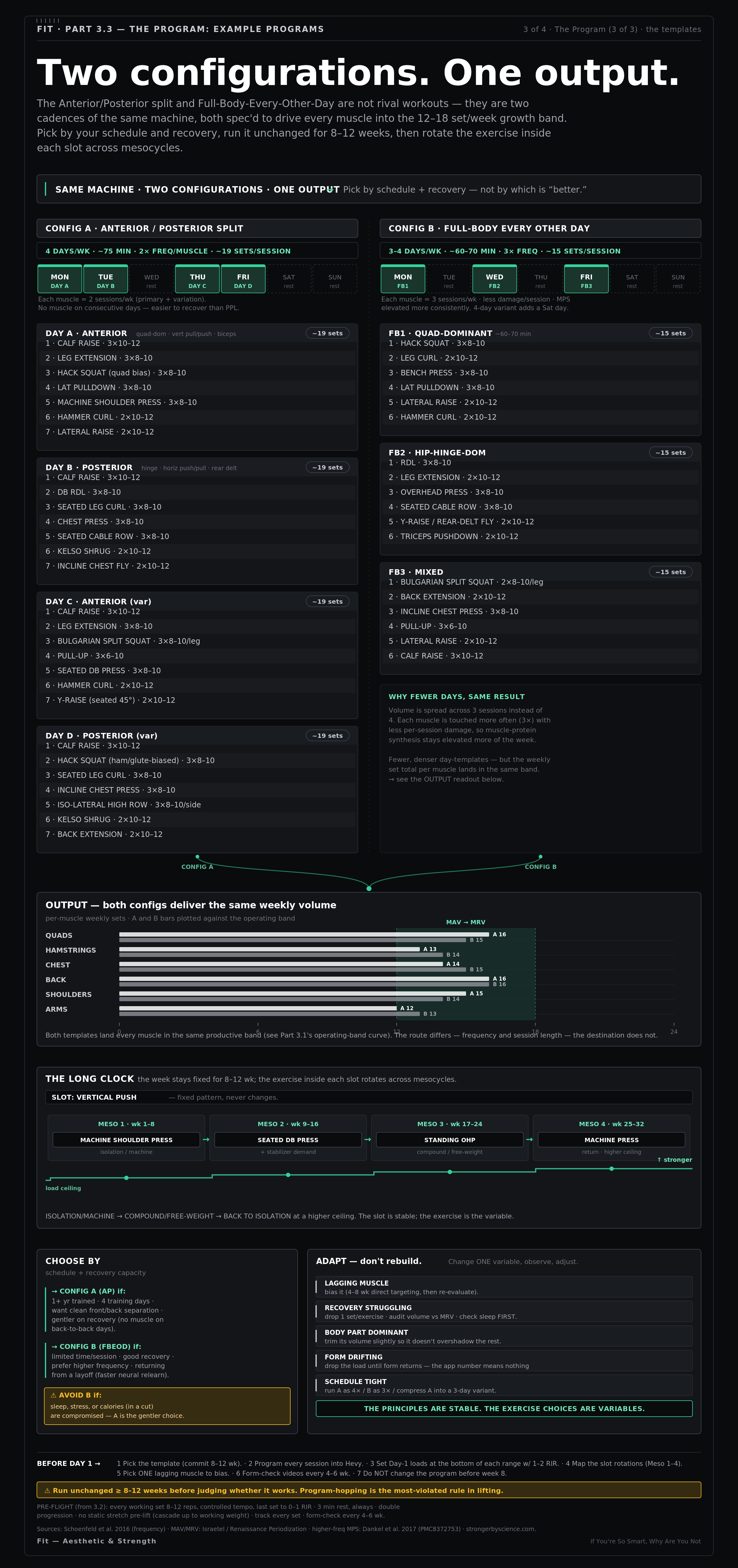
Here’s the whole program on one card — the two templates drawn as two configurations of the same machine: Posterior split (4 days, 2× frequency) and Full-Body Every Other Day (3 days, 3× frequency). Different weekly cadence, identical output — both drive every muscle into the same 12–18 set/week MAV→MRV band, so you pick by schedule and recovery, not by which is “better.” Underneath runs the long clock — the progression cycle, where the exercise inside each slot rotates isolation → compound → isolation-at-a-higher-ceiling while the slot itself never moves — plus the selector and adaptation levers for tuning it to you. Pick a column, run it unchanged for 8–12 weeks, then rotate the slots — pin it beside the rack.
Part 3.3 Takeaways
Key concepts to internalize
Two viable templates, same goal. AP split (4 days, 2× frequency per muscle) and FBEOD (3–4 days, 3× frequency per muscle) both produce hypertrophy. Pick on schedule and recovery capacity, not on which is “better.”
Each muscle hits MAV-to-MRV. Both templates land in the 12–18 sets/muscle/week range, which is the productive zone for intermediate naturals.
Variation lives at the exercise slot, not the pattern. The pattern (vertical pushing, horizontal pulling) is fixed; the exercise filling that slot rotates across mesocycles.
The progression cycle keeps gains alive long-term. Isolation → compound → back to isolation at a higher ceiling. Each transition resets neural adaptation without losing the hypertrophy work.
Adapt, don’t rebuild. Lagging muscle? Bias it. Recovery struggling? Drop a set. Form drifting? Drop the load. Don’t burn the program down — change one variable, observe, adjust.
Your First-Mesocycle Task List
Lock these in before Day 1 of week 1.
- Pick the template. AP split or FBEOD. Decide based on training days available and recovery capacity. Write the choice down and commit to 8–12 weeks.
- Program every session into Hevy. Exercise, set count, rep range, starting weight. Use the tables above as the literal source. Don’t improvise on Day 1.
- Set realistic Day 1 loads. Pick a weight where you can hit the bottom of the rep range (8 reps for an 8–10 range) with 1–2 RIR on the last set. If you’re unsure, go lighter — double progression makes the first 2 weeks fast.
- Plan the mesocycle map. For each compound slot, write down what it’ll be in Mesocycle 1, 2, 3, 4 (e.g., Machine Press → DB Press → OHP → Machine Press at higher load). 8 weeks per mesocycle.
- Identify your lagging muscle. Pick one. Add a biasing exercise as a direct set in the relevant session. This is the muscle you’ll attack for the next 4–8 weeks before re-evaluating.
- Set the form-check video schedule. Pick a day every 4–6 weeks. Record working sets on the three most-loaded compounds. File them somewhere comparable.
- Do not change the program before week 8. Write this on the calendar. Program-hopping kills the adaptation curve, and the rule from Part 3.2 is the most violated rule in lifting.
Recap and what's next That's the full programming layer of the series:
- Part 3.1 — Concepts — fatigue/stimulus, progressive overload, biasing, MRV
- Part 3.2 — Rules and Building Blocks — the rules and structural pieces
- Part 3.3 (this article) — templates that put it all together
Up next: Part 4 — Pharmacology covers the supplement side, both the natural tier and the half-natty peptide tier.
If Part 1 or Part 2 were skipped, start there — they’re the foundation everything in this article relies on.
Disclaimer Not coaching or training advice. These templates reflect general principles and one practitioner's structure. For new lifters or anyone with joint issues, getting a handful of sessions with a qualified coach to dial in form is worth more than any program on the internet.
Sources & references
Recap and what's next That's the full programming layer of the series:
- Part 3.1 — Concepts — fatigue/stimulus, progressive overload, biasing, MRV
- Part 3.2 — Rules and Building Blocks — the rules and structural pieces
- Part 3.3 (this article) — templates that put it all together
Up next: Part 4 — Pharmacology covers the supplement side, both the natural tier and the half-natty peptide tier.
If Part 1 or Part 2 were skipped, start there — they’re the foundation everything in this article relies on.
Disclaimer Not coaching or training advice. These templates reflect general principles and one practitioner's structure. For new lifters or anyone with joint issues, getting a handful of sessions with a qualified coach to dial in form is worth more than any program on the internet.