This is Part 3 of 4 in the Fitness Series. The full path:
- Part 1 - The Goal (2 sub-articles):
- Part 2: Structure of a Day - the daily framework
- Part 3 - The Program (3 sub-articles):
- Part 3.1 (this article): Concepts - the conceptual foundation
- Part 3.2: Rules and Building the Program - contexts
- Part 3.3: Example Programs - practicalities
- Part 4: Pharmacology - supplements and beyond
Table of Contents
- Why split this into three articles
- Fatigue vs. stimulus — the core economy
- Adaptation — the timeline
- Strength and size are linked (recap from Part 1.1)
- Progressive overload: the by-product, not the cause
- Biasing: severe targeting beats fake “isolation”
- MRV: Maximum Recoverable Volume
- Part 3.1 Takeaways
- Your Concept-to-Action Task List
- Sources & references
Why split this into three articles
Part 1 was about deciding what phase to be in. Part 2 was the daily structure around the goal. Part 3 is the actual training — and there’s enough to cover that it needs to be split into three:
- Part 3.1 (this one) — the concepts that make a program work. Fatigue economics, progressive overload, biasing, MRV.
- Part 3.2 — Rules and Building the Program — the rules that turn concepts into a working program, plus the structural pieces (joint movements, main vs. accessory, splits).
- Part 3.3 — Example Programs — the actual templates you can run, week by week.
Read them in order. Each one builds on the last.
Fatigue vs. stimulus — the core economy
Every set produces two things: a stimulus (signal to grow) and fatigue (cost paid). The whole game of programming is maximizing the ratio of stimulus to fatigue. They can’t be separated entirely — fatigue is part of the price of stimulus — but it’s absolutely possible to train in ways that produce mostly fatigue with very little stimulus, which is the worst place to be.
The limited budget The body has a limited budget of two things — fuel (protein, amino acids, calories) and signal (the repair/growth response). Every training session draws from both budgets. If too much fatigue gets generated, all of that fuel and signal goes toward repairing the damage from the workout itself, not toward building new muscle on top of baseline.
This is why the “more is better” instinct fails. It’s also why several popular ideas don’t actually produce growth the way people think they do:
- Microtearing as the goal of training. The “tear it down to build it back up” framing is misleading. Excess micro-trauma just means more of the body’s repair budget is consumed restoring baseline — there’s nothing left over to build with. Growth comes from mechanical tension and sufficient signal, not from how destroyed a muscle feels afterward.
- High-rep, low-load chasing of “the burn.” Above ~20 reps with low loads, you accumulate metabolic stress and discomfort but stop recruiting the high-threshold motor units that drive hypertrophy. You’re paying fatigue without getting stimulus.
- Long sessions of junk volume. Sets in the 4–6 RIR range that never approach failure generate cumulative fatigue with very little growth signal. That’s the hallmark of a session that “feels hard” but doesn’t move the needle.
The simple test If a session ended with the lifter feeling demolished but never actually pushed close to failure on the working sets, a lot of fatigue was generated with little stimulus.
You don't get bigger by being more tired. You get bigger by sending a clear growth signal and having enough resources left to act on it.
Adaptation — the timeline
When starting any new program (or even a new exercise), adaptation happens in two waves:
- Neural adaptation comes first. In the first 4–8 weeks, weights climb fast — not because muscle is being built that quickly, but because the nervous system is learning. Motor unit recruitment improves (untrained people can only access ~60–70% of their muscle voluntarily; trained lifters get much closer to 100%), rate coding improves, and the inhibitory brakes the CNS uses to protect joints and tendons get partially released.1 Most of the early gains are neural.
- Hypertrophy dominates from roughly week 4 onward, with the contribution growing over months and years. Connective tissue (tendons, fascia) adapts even more slowly — that’s a 6–24 month process.
Why this matters for programming Changing an exercise resets the neural adaptation curve and produces fast initial progress. Don't mistake that for hypertrophy progress. The "I added 20 kg in three weeks on this new exercise" excitement is mostly neural — real growth is what happens after that initial bump, when progression slows to its honest pace of 2.5 kg every 1–3 weeks.
Strength and size are linked (for naturals especially)
The chain looks like this:
more strength → more force production → more motor units recruited per set → more fibers stimulated → more growth signal → more fiber → more strength next time
Strength and hypertrophy aren’t identical — a powerlifter and a bodybuilder of the same muscle mass will have different strength numbers because of neural and skill specificity.2 But they are correlated, and for natural lifters they’re correlated tightly enough that chasing strength on the right exercises is a reliable proxy for chasing size.
This sets up the next concept directly.
Progressive overload: the by-product, not the cause
This is the most misunderstood concept in training, and it’s worth being precise about.
Reframe Progressive overload is a by-product of doing the right things, not the cause of growth itself. People talk about "progressively overloading the muscle" as if adding weight to the bar is what makes the muscle grow. It isn't.
The muscle grows in response to mechanical tension and sufficient stimulus. Progressive overload is just the signal that the program is working — the visible, trackable evidence that adaptation is happening.
This distinction matters because it changes how to think about training. The goal isn’t “add weight every week.” The goal is “send a strong growth signal every session.” When that signal is strong and consistent, progressive overload happens automatically over time. Trying to force overload by adding weight before the body is ready is how form breaks down, injuries happen, and progress stalls in the worst way.
Types of progressive overload, ranked
Not all overload is equal. There’s a hierarchy, from most to least useful:
- Increased weight at the same reps and form. Same sets, same reps, more load — this is the cleanest signal of true strength and hypertrophy progress. The gold standard.
- Improved RPE / Rate of Perceived Exertion at the same weight and reps. The lift “feels easier” — that’s neural efficiency improving and is a real precursor to load increases. RPE 9 last week becoming RPE 7 this week at the same weight means an upgrade is coming.
- Increased reps at the same weight. This is the second half of double progression. When the top of the rep range is hit on all working sets, the next session goes up in load. (Sometimes a micro-load — 1 kg or 0.5 kg increment — is needed if 2.5 kg is too aggressive.)
- Improved RIR / Reps in Reserve. Pushing closer to failure at the same weight and reps. Going from 2 RIR to 0 RIR is a real overload event because more high-threshold fibers are now being recruited.
- Increased 1RM, then more sets at 80% of 1RM. Last in the hierarchy because it’s the most fatigue-heavy way to drive growth and the hardest to sustain. Useful periodically as a benchmark, not as a primary driver.
The hierarchy matters because chasing the wrong type at the wrong time leads nowhere. Trying to add weight every session when neural adaptation has already plateaued just pushes form to break down. Hammering more sets when intensity could go up is volume creep that eats recovery without driving stimulus.
The mistake people make on progressive overload
Here’s the trap that catches almost everyone, and it’s worth flagging clearly:
Fake progressive overload The same lift can be performed by different muscle groups depending on form, leverage, and which muscles are dominant. Some muscle regions are naturally stronger than the target muscle in any given lift.
- On a flat bench press, the triceps are often stronger than the chest.
- On a row, the biceps and rear delts are often stronger than the lats.
- On a squat, the quads can take over from the hamstrings and glutes if the form drifts.
What this means in practice: as the weight goes up, the dominant accessory muscles can quietly take over the lift, and the lifter looks like they’re progressing when they’re really just shifting load to a different muscle group. The bench press number is climbing, but it’s the triceps that grew, not the chest.
This is fake progressive overload. It produces a number on a tracking app but no growth in the muscle the program was supposed to target.
How to catch it:
- Video form checks every few weeks. Compare current form to form 4–8 weeks ago. If the bar path, depth, or torso angle has shifted, the muscle being trained has shifted with it.
- Mind-muscle connection during the set. If a movement that used to “feel” in the target muscle now feels in a different muscle, the recruitment pattern has changed.
- Cross-check with isolation movement progress. If chest press is climbing but pec deck and chest fly aren’t, the chest probably isn’t the muscle doing the work on chest press.
If form has shifted Drop the load until the form returns. The number going down temporarily is the price of making sure progress is real.
Biasing: severe targeting beats fake “isolation”
Honest framing first: there’s no such thing as truly isolating a muscle. The body works as a system. Every “isolation” exercise still recruits stabilizers, accessories, and synergists to some degree. So what’s actually being talked about is ==severe biasing== — picking exercises and form that load one muscle group as heavily as possible relative to the others involved.
PS to the pedants The "well, actually you can't fully isolate any muscle" objection is technically correct. We're calling it biasing because that's what it is: shifting the bias of the work toward one target. Cool? Cool.
Biasing is what makes the difference between a generic program and a targeted one. There are two layers to it.
Direct sets vs. indirect sets
A direct set is when the target muscle is the primary mover. An indirect set is when the target muscle is significantly involved but not primary.
For example: the chest gets direct work from bench press and chest fly, and indirect work from overhead press and dips. Both contribute to total weekly volume for the chest, but they don’t count equally — direct sets are weighted ~1.0, indirect sets are usually weighted ~0.5 in volume calculations.
Main muscle region vs. accessories
Every exercise has a primary target (the main muscle region) and secondary targets (the accessories).
- Bench press primarily targets the chest, with triceps and front delts as accessories.
- Pulldown primarily targets the lats, with biceps and rear delts as accessories.
The implication for programming: when building a session, count direct sets toward the primary muscle’s weekly volume target, and treat accessory muscle stimulus as part of the indirect contribution. This is what stops a program from accidentally over-training accessories (like triceps and biceps, which get hammered indirectly through every press and pull) while under-training primary muscles.
MRV: Maximum Recoverable Volume
The last concept needed before rules and structure: MRV — Maximum Recoverable Volume. This is the volume framework developed by Mike Israetel and the team at Renaissance Periodization, and it’s one of the most useful programming concepts to internalize.3
The full landmarks look like this:
| Landmark | Definition | Typical range |
|---|---|---|
| MV (Maintenance Volume) | The minimum to maintain existing muscle | ~6 sets/muscle/week |
| MEV (Minimum Effective Volume) | The lowest volume that actually produces growth | 8–12 sets/muscle/week |
| MAV (Maximum Adaptive Volume) | The sweet spot range that produces the most growth | 12–20 sets/muscle/week |
| MRV (Maximum Recoverable Volume) | The upper limit. Beyond this, recovery fails and gains stop | 18–25 sets/muscle/week |
MRV is individual Genetics, sleep, stress, training age, and recovery resources all shift it. Total daily sets should be dependent on what you believe you can recover from reasonably. Someone who can only recover from 12 total sets per session needs to be more selective with exercise choice and set numbers than someone who can recover from 20.
This concept ties directly back to fatigue vs. stimulus: training above MRV is the perfect example of generating fatigue without generating stimulus. The fuel and signal budget gets entirely consumed by recovery, with nothing left over for growth.
Knowing your real MRV is hard
You can be theoretical and pick numbers from a chart, but the most reliable way to actually know is observation over time:
- Did performance go up week-over-week, or did it stagnate or drop? If it dropped consistently, MRV was probably exceeded.
- Did the same load feel heavier across sessions despite no change in nutrition or sleep? Same answer.
- Did motivation and recovery markers (mood, sleep quality, joint feel) deteriorate over the cycle? Same answer.
This is where wearable technology becomes useful. A device like WHOOP, Garmin, or Oura tracks recovery score, HRV, resting heart rate, and sleep stages — giving objective data on how recovered the body is from the previous session’s strain.
The correlation chain how recovered → how much stimulus can be generated this session → how much progress can be made
A high recovery score is permission to push toward MRV that day. A low recovery score is information that volume needs to come down or rest needs to extend. Over weeks, the pattern shows where actual MRV sits, and the program can be adjusted around real data instead of guesses.
(Practical baseline: most intermediate natural lifters land at 12–18 sets/muscle/week as their MAV-to-MRV range. Start in that band, observe recovery, adjust from there.)
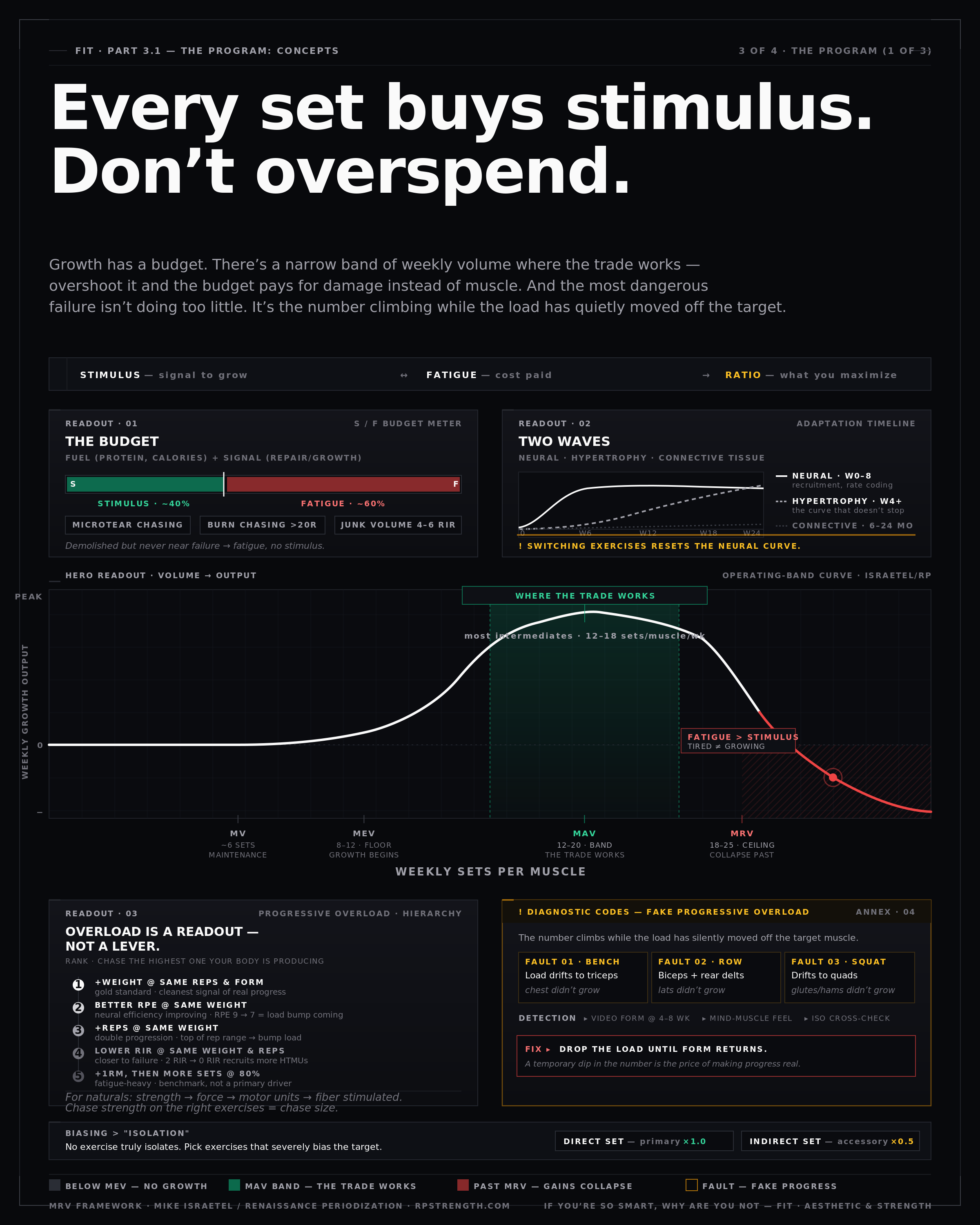
Here’s a clean way to picture the conceptual machinery a program runs on: one hero operating-band curve plotting weekly sets per muscle against growth output, with the MV → MEV → MAV → MRV landmarks ticked along the x-axis and the MAV sweet spot shaded as the band where the trade works. Hanging off it are the satellite readouts — a fatigue split-meter (the budget made literal), a neural-vs-hypertrophy adaptation inset, the progressive-overload ladder ranked top-to-bottom, and a fake-PO fault annex flagging the bench / row / squat traps where the number climbs but the target muscle doesn’t grow. Growth is bought, not earned by being tired — there’s a narrow band where the trade works, and outside it the budget pays for damage instead of muscle. Pin it up and read each program against the curve.
Part 3.1 Takeaways
Key concepts to internalize
- Fatigue vs. stimulus is the core economy. Every set costs fatigue and produces stimulus. The goal is maximizing the ratio. Tired ≠ growing.
- Adaptation comes in two waves: neural first (4–8 weeks of fast climbs), hypertrophy after. Don’t mistake exercise-change excitement for real growth.
- Strength and size are linked for naturals. Chasing strength on the right exercises is the most reliable proxy for chasing size.
- Progressive overload is a by-product, not a cause. Send a strong growth signal; the load increases follow automatically.
- Fake progressive overload is the single biggest trap. When form drifts, load shifts to dominant accessories. The number goes up; the target muscle doesn’t grow.
- Biasing > “isolation.” No exercise truly isolates a muscle. Pick exercises that severely bias the target relative to the accessories.
- MRV is individual and best discovered by observation. Most intermediate naturals: 12–18 sets/muscle/week. Wearable recovery scores turn this from a guess into a data-driven decision.
Recap and what's next Five ideas to carry into every session: fatigue vs. stimulus, the adaptation timeline, the strength-size link, real vs. fake progressive overload, biasing, and MRV. Everything in the next article is built on these.
Up next:
- Part 3.2 — Rules and Building the Program covers the rules of the program and the structural pieces.
- Part 3.3 — Example Programs gives templates you can actually run.
Disclaimer Not coaching or training advice. This reflects general principles and the reasoning behind them. For new lifters or anyone with joint issues, getting a handful of sessions with a qualified coach to dial in form is worth more than any program on the internet.
Sources & references
Footnotes
-
Neural adaptations to resistance training (motor unit recruitment, rate coding, reduced inhibition): foundational neuromuscular physiology. See Bazgir et al. on satellite cells and broader review at PubMed Central — PMC5086326. ↩
-
Strength vs. hypertrophy distinction and sport specificity: see ScienceDirect — Load-induced human skeletal muscle hypertrophy for review of muscle adaptations to resistance training. ↩
-
MRV / MEV / MAV framework: developed by Mike Israetel, with detailed treatment at rpstrength.com — training volume landmarks and revivestronger.com — what is MRV. See also Israetel et al., “Mesocycle Progression in Hypertrophy: Volume versus Intensity” (Strength & Conditioning Journal, 2020). ↩