This is Part 2 of 4 in the Fitness Series. The full path:
- Part 1 - The Goal (2 sub-articles):
- Part 2 (this article): Structure of a Day - the daily framework
- Part 3 - The Program (3 sub-articles):
- Part 3.1: Concepts - the conceptual foundation
- Part 3.2: Rules and Building the Program - contexts
- Part 3.3: Example Programs - practicalities
- Part 4: Pharmacology - supplements and beyond
Table of Contents
- Partitioning: Managing the Storage Units
- The day, hour by hour
- The Pomodoro stack — low-friction compounding
- What to prep in advance
- Part 2 Takeaways
- Your Daily Task List
- Sources & references
Disclaimer This routine will feel more natural to people who work from home or have flexible workspaces. If that's not your situation, find a workaround that fits your environment — the underlying science doesn't change. The principles below (insulin sensitivity windows, GLUT4 activation, fasting timing) are universal; the specific habits used to express them are negotiable.
Here is where things get interesting. If you did the proper work in Part 1.1 - What Actually Matters (Baseline) and Part 1.2 (Maintenance), Part 2 becomes simple. There are only two primary variables that dictate your success:
- The Intensity of your workout (The Demand).
- Your Food Intake (The Supply).
Understanding and tracking your calories is the key lever for growth because it dictates what we call Fuel Partitioning.
Partitioning: Managing the Storage Units
When you eat, your body has to decide: does this energy go to muscle, or does it go to fat? This is governed by Insulin Sensitivity.
- High Sensitivity: Your muscles are “hungry.” Insulin signals the GLUT4 transporters to come to the surface and pull glucose into the muscle for repair and growth.
- Insulin Resistance: Your muscles are “full” or “deaf.” The energy has nowhere to go but into adipose tissue (fat storage).
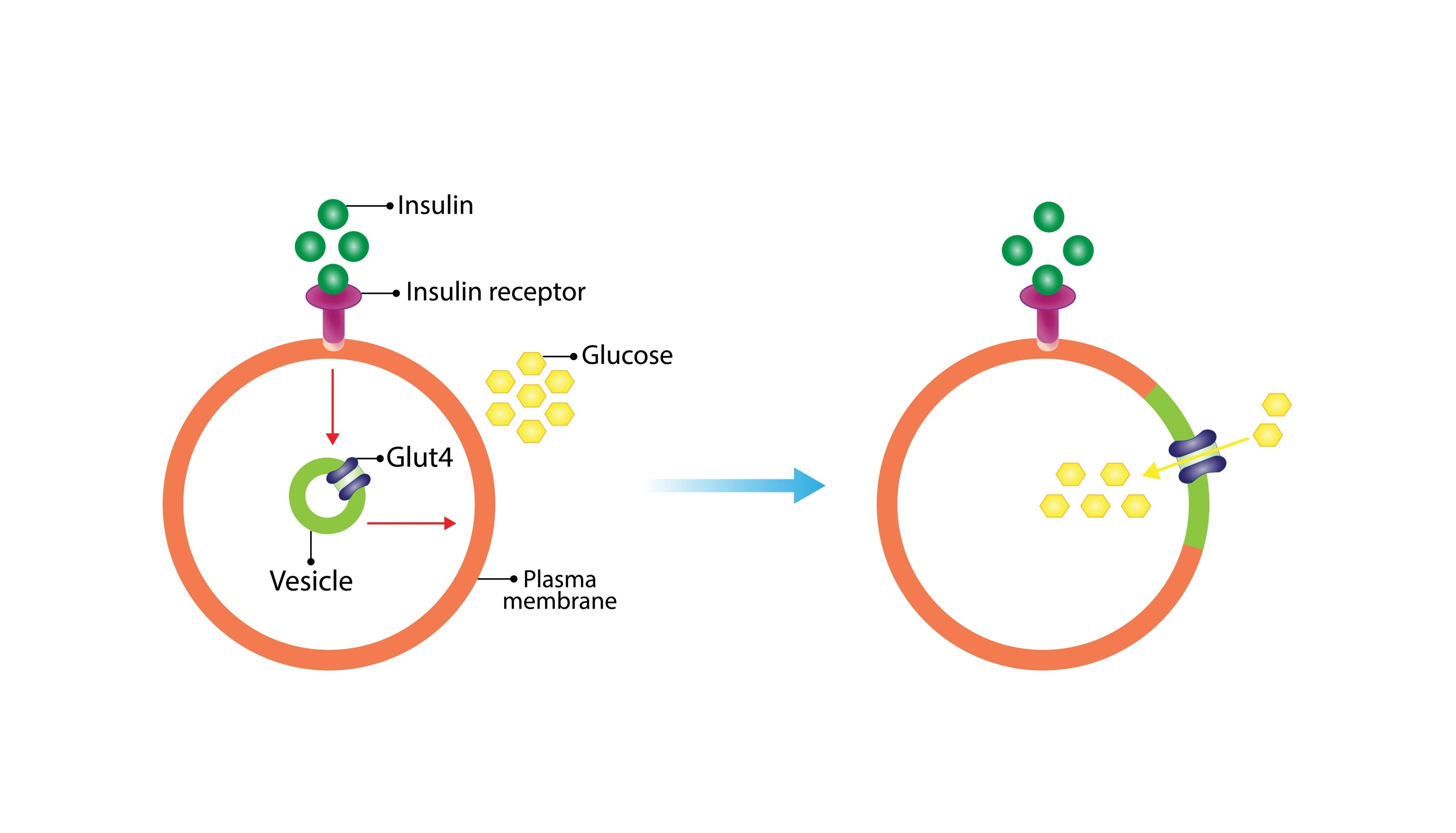
By following the timing and movement habits below (like the post-meal walk), you are essentially “hacking” your partitioning to ensure that every calorie you track in Part 1 is used for the work we do in Part 3.
The day, hour by hour
Wake up — weigh in immediately
First thing, before food or water of any consequence, step on the scale. As covered in Rule 1, daily weights are noisy — but the trend over a rolling 7-day average is the only number that matters.
Fast 12–14 hours daily
A 12–14 hour fasting window, mostly overnight plus a bit into the morning. The reason isn’t aggressive fat loss — moderate time-restricted eating doesn’t accelerate weight loss versus the same calories spread evenly. The reason is insulin sensitivity and mitochondrial health.1 A consistent fasting window keeps baseline insulin low, gives insulin receptors a daily “reset,” and supports healthier mitochondrial turnover. It also makes the day simpler — fewer feeding decisions to make.
Don't push past 16 hours regularly Stretching the fast past 16 hours regularly is counterproductive. Beyond that point, cortisol rises faster than the autophagy benefits scale, and for a natural lifter cortisol is a muscle problem.
Short, consistent fasts beat long, occasional ones.
Eat carbs only when usable
This is the rule that changes the most for people. Carbs are most useful in two windows: 2–3 hours before a workout, or any time movement is possible afterward.
The mechanism is GLUT4, covered in Rule 2. Carbs eaten before sitting at a desk for four hours have nowhere productive to go. Carbs eaten before training, or before a walk, get pulled into muscle as glycogen. Same calories, completely different outcome.
So the rule is: carbs only enter the day when there’s a plan for what to do with them. Pre-workout meal, post-workout meal, or before/around a walk. Sitting still for hours afterward → eat protein and fat instead.
Workout block — 2 hours allocated
Block two hours total per training day. That’s not 2 hours of lifting — it’s 1 hour of prep (pre-workout meal/supplements, packing the bag, getting to the gym) plus a 60–75 minute lifting session plus the buffer to get home and eat.
The actual lifting is the smallest part of that block. Anything past 75 minutes of working sets has diminishing returns — fatigue accumulates faster than stimulus, and the last few sets are worse than the first few. Better to keep sessions tight. Programming details are covered in Part 3.
Walk after meals — or use the air-squat trick
This is the highest-leverage habit to add. After every meal that contains carbs, muscle contraction needs to happen within the next 30–60 minutes to drive that GLUT4 activation.
The cleanest version A 10–15 minute walk after the meal. That's enough to meaningfully blunt the glucose spike and shift glucose into muscle glycogen rather than fat. Even a 2–5 minute walk has a measurable effect — it's one of the most disproportionately useful interventions in metabolic health for the time invested. 1
The trick when walking isn't possible During a workday, after the afternoon meal, do 1 minute of air squats every 15 minutes for an hour or two. A Pomodoro timer running in the background makes this automatic — 25 minutes of work, 5 minutes break, and during the break bang out the squats. Same GLUT4 outcome as walking, fits inside a working day, and breaks up sedentary time.
Before sleep — second weigh-in
Second weigh-in of the day. The morning weight is baseline; the evening weight reflects the day’s water and food intake plus salt load. The gap between them is normally 1.5–2.5 kg. If it spikes outside that range or stays narrow when it shouldn’t, that’s information worth tracking.
The Pomodoro stack — low-friction compounding
The air-squat habit was framed above through a Pomodoro timer, but Pomodoro deserves its own section because it’s the single best framework for stacking small, high-leverage habits across a workday.
The standard version is 25 minutes of focused work, 5 minutes of break, repeated. The variation that works better for stacking habits is 45 minutes of work, then a 2–5 minute break — long enough to do something meaningful with the break, short enough that it doesn’t kill momentum.
A break-window stack that compounds across a workday:
- Air squats (1 minute) — post-meal insulin sensitivity boost via GLUT4. Most important during the 1–2 hours after lunch.
- Light movement to increase TDEE — even shaking out the legs, climbing stairs, or pacing the room adds NEAT. NEAT is the most variable component of TDEE — pushing it up by 200 kcal/day across a week is a meaningful calorie buffer.
- 20/20/20 vision concept (modified) — every 45 minutes, look at something 20 feet (~6 meters) away for 1–2 minutes. The standard rule is every 20 minutes; stretching it to every 45 minutes fits the Pomodoro cadence and still meaningfully reduces eye strain and accommodation fatigue.2
- Posture reset + quick stretch — chest opener, hip flexor stretch, neck mobility. Counters the “desk hunch” pattern that compounds across years if untreated.
- Box breathing (4-4-4-4 for 1 minute) — inhale 4 seconds, hold 4, exhale 4, hold 4. Activates parasympathetic nervous system, lowers cortisol, resets focus.
- Sunlight exposure (preferably morning) — even 5–10 minutes of natural light through a window or stepping outside regulates circadian rhythm, improves sleep quality, and has direct effects on mood and testosterone.3
- Hydration check — visible water bottle, refilled at the start of each Pomodoro block. Most people are mildly dehydrated through the workday without noticing.
The principle None of these are dramatic on their own. Stacked together over a workday, repeated daily, the compounding return is real.
This is the lowest-friction way to fit health-supporting habits into a working schedule without needing a separate “wellness routine.”
What to prep in advance
Almost everything that makes this sustainable is a prep decision, not a willpower decision. There are four main buckets.
Meal prep
This is the biggest one. Cooking 2–4 days of meals at once saves time, removes most decision fatigue, and “most importantly” makes calorie tracking trivially accurate. Weighing 200 g of cooked rice and 180 g of grilled chicken at the start of the week makes every meal exactly known. No guessing, no estimating, no “I’ll just log this as ‘medium portion of rice’.”
The phrase “you can’t out-train a bad diet” is overused, but you definitely can’t out-track an unprepped one.
Pill organization
A weekly pill organizer for daily supplements and an alarm-driven system for compounds with timing requirements. The actual pharmacology is covered in Part 4, but the organizational principle is: anything taken more than once a day needs to be visible and pre-portioned, or doses get missed.
The Gym Wardrobe
Stockpile your gym clothes so laundry is never the bottleneck that keeps you from training. Keep multiple sets of clothes and at least one extra pair of gym shoes ready to go. To further reduce friction, opt for versatile pieces—like athletic long pants that easily transition into casual wear. The less you have to think about changing or finding clean gear, the easier it is to just get out the door.
The Gym Bag
Your bag should be fully stocked and permanently packed. If you have to hunt for gear every morning, you will eventually forget something and ruin a session. Keep these essentials inside at all times:
- A lifting belt and lifting straps.
- A gym pin (crucial for adding micro-weights or exceeding cable stack limits).
- A dedicated power bank (a dead phone means no Hevy tracking and no music, which creates massive friction).
- Wired earphones (to completely bypass the risk of dead Bluetooth headphones).
- A clean gym towel.
Hydration & Liquid Fuel
Prep your bottles in advance. Buy as many shaker bottles as possible for your pre-workout and intra-workout drinks so you aren’t forced to hand-wash a single shaker every single day. Alternatively, eliminate prep entirely by buying ready-to-drink options in bulk. Keep your fridge stocked with grab-and-go options like 500ml PET bottles of high-protein Milo (for an easy 25g hit of protein) or flats of Monster Energy for zero-friction pre-workout.
Apps that do the math
Two apps run training and nutrition, and a third audits the results:
- Hevy for the workout program. Logs every set, weight, rep, and RPE, tracks PRs automatically, and shows progression curves over time. The data layer is what makes precise double progression possible (covered in Part 3.2).
- MacroFactor for nutrition. The reason to use this one specifically is its true-weight algorithm — it takes daily weights and computes a smoothed weight trend that filters out noise. It also recalculates actual maintenance calories every week based on what was eaten and what the weight did, removing the entire “is my TDEE estimate accurate” question.
- InBody for body composition tracking. While MacroFactor handles the scale weight, the InBody app logs your skeletal muscle mass and body fat percentage from scans. This ensures the weight you are gaining or losing is actually the right kind of weight.
Smart watch or WHOOP for recovery tracking
A wearable that monitors HRV, resting heart rate, sleep stages, and recovery score. Apple Watch, Garmin, Oura, and WHOOP are all viable — WHOOP is most specifically designed for recovery and training stress, while Apple Watch is the most versatile.
The reason this matters: understanding how recovered the body is from the last session is critical information that should change the program. A high-volume hypertrophy session on a day with a 30% recovery score isn’t going to produce growth, it’ll just dig a fatigue hole. Conversely, leaving an easy day on the table when recovery is at 95% is wasted opportunity.
More on how recovery data feeds into programming decisions in Part 3.1.
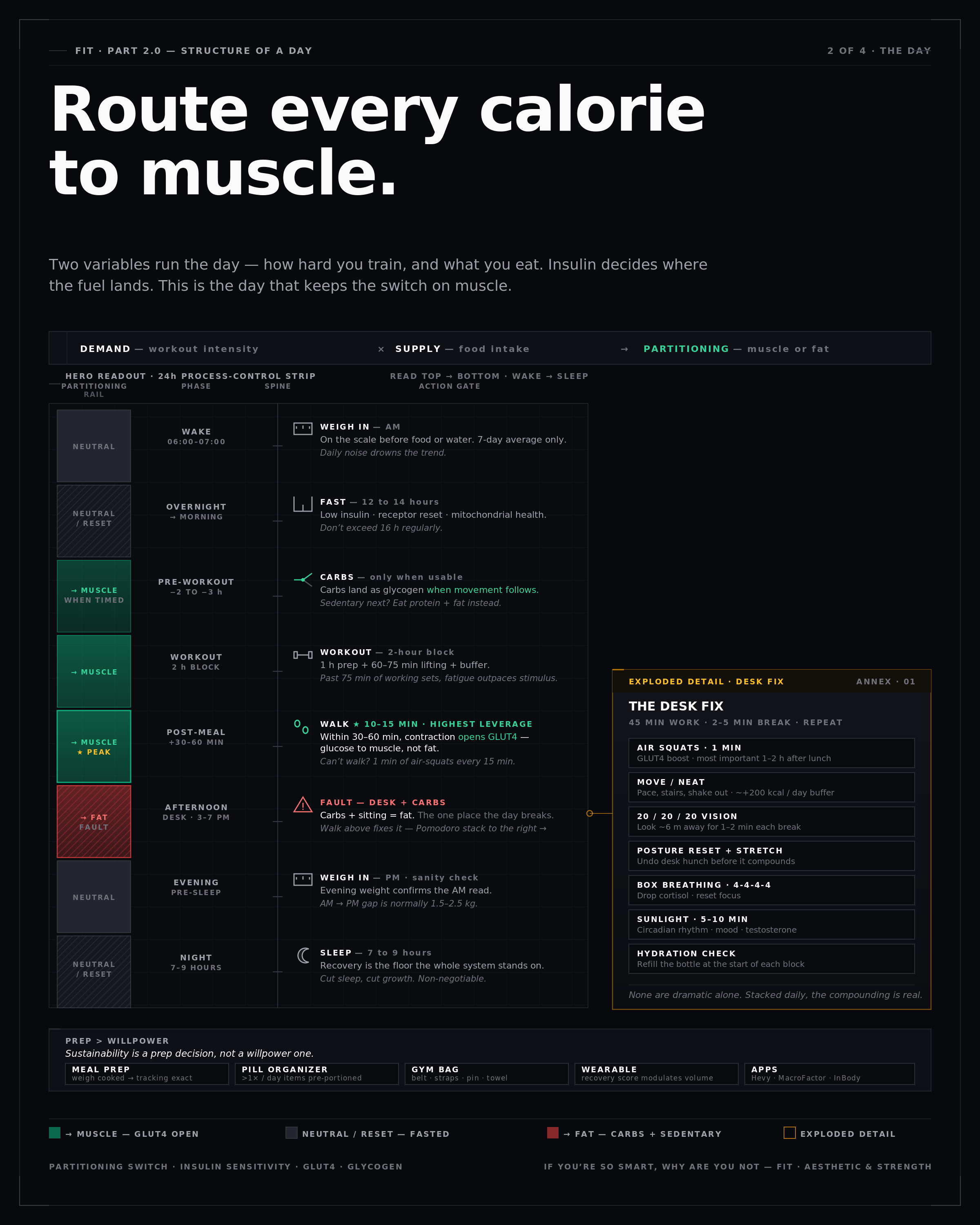
Here’s a clean way to picture the day as one control sequence: a 24-hour day-strip running wake → sleep, with each habit a labeled gate and a “partitioning rail” beside it showing where every calorie is being routed — muscle, neutral, or fat. The same calorie can build muscle or build fat; insulin sensitivity is the switch, and the day is engineered to keep it flipped toward muscle. There’s one avoidable trap (carbs + sitting still) and one habit that fixes it almost everywhere — the post-meal walk, with the Pomodoro stack as the desk-day workaround. Pin it up and run the day off it until it’s automatic.
Part 2 Takeaways
Key concepts to internalize
- Two variables drive everything: workout intensity (demand) and food intake (supply). The day’s structure exists to optimize the meeting point.
- Partitioning is the mechanism: insulin sensitivity decides whether calories go to muscle or fat. The whole day is built to keep partitioning favorable.
- Two weigh-ins, one signal: morning weight feeds the 7-day rolling average. Evening weight is a sanity check for water/salt load.
- Carbs only when usable: 2–3 hours pre-workout, or any time movement is possible afterward. Sitting still after carbs is the worst-case partitioning scenario.
- The post-meal walk is the highest-leverage habit: 10–15 minutes activates GLUT4 and shifts glucose into muscle glycogen instead of fat storage. Air squats at a desk produce the same effect when walking isn’t possible.
- Pomodoro stacks compound: air squats, posture resets, vision breaks, box breathing, sunlight — none are dramatic alone, but daily repetition is the actual lever.
- Prep wins, willpower loses: meal prep makes tracking accurate, pill organizers prevent missed doses, apps remove math, wearables flag overreach. The four buckets are non-negotiable.
Your Daily Task List
This is the daily structure to actually execute. Most of these will become automatic within 2–3 weeks.
- Wake up → weigh in immediately — log the number into MacroFactor (or your tracking app of choice).
- Hold the fast to 12–14 hours — water, black coffee, and tea are all fine. Don’t extend past 16 hours regularly.
- Plan carbs around movement — pre-workout meal, post-workout meal, or pre-walk meal only. If sedentary for the next 4+ hours, eat protein + fat instead.
- Walk 10–15 minutes after every carb-containing meal — non-negotiable. If you can’t walk, do 1 minute of air squats every 15 minutes for the next hour.
- Run a Pomodoro timer through the workday — pick 2–3 break-window habits to stack (air squats + posture reset is the bare minimum).
- Prep meals 2–4 days at a time — weigh portions cooked, log them once, replicate.
- Check the wearable’s recovery score before training — let it modulate volume/intensity for the day.
- Second weigh-in before sleep — confirm the morning-to-evening gap is in the normal 1.5–2.5 kg range.
- Sleep 7–9 hours — the foundation for both the recovery score being honest and the next day’s training being productive.
Recap and what's next The daily structure isn't arbitrary. Every habit is the practical expression of either Rule 1 (true weight) or Rule 2 (insulin activation), supported by the calorie framework from Part 1.2. The Pomodoro stack ties it all together inside a working day so none of it requires extra time slots.
Up next: Part 3.1 — The Program: Concepts covers the conceptual foundation of training.
Part 4 — Pharmacology covers what to take and why.
Disclaimer Not medical advice. Everything here reflects personal experience and reading of the research. Consult a medical professional before making significant changes to diet, training, or supplement protocol — especially with underlying health conditions.
Sources & references
Footnotes
-
Time-restricted eating effects on insulin sensitivity and mitochondrial function: meta-analyses generally find no fat loss advantage over isocaloric distributed eating, but improved insulin sensitivity and metabolic markers are well-documented. ↩
-
20/20/20 rule for digital eye strain: standard ophthalmology recommendation is every 20 minutes look at something 20 feet away for 20 seconds; the modified 45-minute version trades frequency for compatibility with deep-work blocks and longer fixation per break. ↩
-
Morning sunlight exposure regulates circadian rhythm via melanopsin receptors, with downstream effects on sleep timing, mood, and hormonal cycles. Discussion in Huberman Lab content and broader chronobiology literature; Lockley et al. on circadian phase response to morning light. ↩