This is Part 1 of 4 in the Fitness Series. The full path:
- Part 1 - The Goal (2 sub-articles):
- Part 1.1: What Actually Matters
- Part 1.2 (this article): How to Actually Decide
- Part 2: Structure of a Day - the daily framework
- Part 3 - The Program (3 sub-articles):
- Part 3.1: Concepts - the conceptual foundation
- Part 3.2: Rules and Building the Program - contexts
- Part 3.3: Example Programs - practicalities
- Part 4: Pharmacology - supplements and beyond
Table of Contents
- Why bulking is overrated for naturals
- The four phases: When each one applies
- The decision tree
- The two rules underneath everything
- Finding maintenance calories — the 2-week lock-in
- The Fitness Forecast
- Part 1.2 Takeaways
- Your Week 1–2 Task List
Part 1.1 established the what, what gets measured, (i.e why FFMI matters more than scale weight), and why strength is the natural lifter’s most honest proxy for size. This article is the how: given your current numbers, how do you decide whether to recomp, cut, or bulk and how do you actually find the calorie anchor that makes any of those decisions executable?
The four phases: When each one applies
It all boils down to calories. Here’s the framework.
Recomposition — the default
Eat at maintenance (or a tiny deficit/surplus, depending on the day). Train hard. Slowly build muscle and slowly lose fat at the same time. Progress is real but undramatic, visible more clearly in the mirror and in the lifts than on the scale.
NOTE
More about Maintenance Calories at Finding maintenance calories below.
This is the default phase to operate in for most natural lifters. Recomp works at any reasonable body fat: beginners, returning lifters, and intermediates can all make progress this way. The only reason to shift away from recomp is when one variable becomes more urgent than the other: fat loss takes priority when body fat is low and require aggressive cutting (due to lower bodyfat your body burn fat slower), and a small surplus takes priority when already lean and wanting size to grow faster.
Cut — when you “almost see your abs”
Eat in a meaningful deficit (typically 500–750 kcal/day, more aggressive for shorter mini-cuts) until reaching the body fat percentage you want. Protein stays high (1.6–2.2 g/kg, possibly higher for naturals). Training intensity stays the same, volume can come down slightly to accommodate reduced recovery. The point of a cut isn’t to build muscle, it’s to remove fat without losing what’s already built.
Lean bulk — only after the abs are visible
This is the rule worth being most opinionated about.
Don't lean bulk until lean enough to see your abs. Below ~12% body fat for men, insulin sensitivity is at its best, partitioning favors muscle over fat, and there's visual room to add a bit of fat without looking out of shape. A small, controlled surplus (200–300 kcal/day) at this body fat level builds muscle efficiently and minimizes the cut needed later.
”Bulk” — basically never, for naturals
The only reason to do an old-school dirty bulk is for specific reasons to prioritize raw strength gains over physique (powerlifting prep, etc.) and not minding looking soft for a stretch. For physique-focused training as a natural lifter, the math doesn’t work.
Why bulking is overrated for naturals
Traditional bulking, eating in a meaningful surplus to “feed muscle growth” was built around enhanced lifters’ physiology. On steroids, insulin sensitivity goes up, nutrient partitioning shifts dramatically toward muscle, and excess calories actually do drive more lean tissue (along with some fat). Enhanced lifters can also tolerate aggressive cuts later because exogenous androgens protect muscle from catabolism.
Naturals don’t have any of that. A natural in a 500 kcal/day surplus is mostly storing fat with a small fraction going to muscle. And then the cut becomes the problem, the moment a natural drops calories aggressively, muscle catabolism becomes a real threat because the body, deprived of energy, will burn whatever it can, including hard-earned tissue, unless training stimulus and protein signaling are dialed in.[^10]
The trap Three months eating big, gain 4 kg of muscle and 6 kg of fat. Then four months cutting and lose the 6 kg of fat plus 2 of the 4 kg of muscle.
Net: 2 kg of muscle in seven months, with a long stretch of not looking great.
That’s the trap that gave rise to two better strategies for naturals: lean bulking and recomposition.
The decision tree
Practically, this collapses into something simple:
- 18% and above ~20% body fat → Recomp by default. Maintenance calories, intense training, monitor weekly. Fat loss becomes the natural, and size naturally comes in. You’ll also feel and perform better, and the subsequent cut or lean bulk will be far more efficient.
- 12–17% body fat → Choose the priority. To keep getting leaner, finish the cut. If size has been the bottleneck and strength is climbing fast, transition to a lean bulk.
- Below 12% with visible abs → Lean bulk in a small surplus until drifting back to ~15%. Then mini-cut back down. Repeat.
This is roughly the 10–20% oscillation that most experienced naturals settle into. Most of the year is spent somewhere in that band, alternating between mild surplus and mild deficit, with the long-term trajectory pointing toward more muscle at the same body fat over years.
The two rules underneath everything
Almost every habit in this series maps back to one of two underlying principles. Internalize these two and the rest of the daily structure starts to make itself.
Rule 1: Understand “true weight”
A single morning weigh-in is mostly noise. Sodium yesterday, sleep last night, glycogen levels, bowel timing — all of these can swing the number by 1.5 kg in either direction without any change in actual body composition. Daily weight fluctuates. True weight does not.
Definition True weight is the rolling 7-day average of morning weigh-ins. That's the number that tracks reality. Compare this week's average to last week's average to know whether you're actually gaining, losing, or maintaining.
The manual version: weigh in every morning, write the number down, and at the end of the week average the seven numbers. Compare that average to the previous week’s. If using MacroFactor or a similar app, it does this automatically and does it better — its smoothing algorithm handles missing days and outliers more cleanly than a simple average.[^1]
The reason this matters is that without true weight, noise gets mistaken for signal. People panic about a 1 kg “gain” that’s just last night’s sushi. People celebrate a 1 kg “loss” that’s just a dehydrated morning. Cuts get abandoned because they “stalled” when they didn’t. Bulks run past 18% body fat because the lifter “wasn’t gaining.”
Rule 2: Understand insulin activation
Everything in the day’s structure — the fasting window, carb timing, post-meal walks, air squats — is a tool for managing one variable: how much of the day is spent with elevated insulin.
Insulin isn’t bad. It’s an essential hormone, and it’s needed to drive nutrients into muscle. But chronically elevated insulin is a problem, and that’s what most modern eating patterns produce — elevated insulin from the moment breakfast starts until well after dinner.
The principle: big insulin spikes belong at moments when muscles are hungry for glucose (around training, around movement). Low insulin baseline belongs the rest of the time. That combination is what produces both good body composition and good metabolic health long-term.
The GLUT4 mechanism GLUT4 is a glucose transporter that lives inside muscle cells and only moves to the cell surface when called. Two things call it: insulin (after eating) and muscle contraction (training, walking, even air squats).
When both signals fire together — carbs in, body moving — glucose gets pulled into muscle cells far more efficiently and stored as glycogen rather than ending up in fat storage.[^2]
That’s the entire game. Every habit below is essentially an expression of these two rules.
Finding maintenance calories — the 2-week lock-in
This article keeps referencing “maintenance calories” — recomp eats at maintenance, cuts go below it, lean bulks go slightly above it. The most common follow-up question is: how do you actually find your maintenance number?
What is TDEE?
TDEE — Total Daily Energy Expenditure — is the total number of calories the body burns in a day. It’s the sum of four components:
- BMR (Basal Metabolic Rate) — calories burned just keeping the body running at rest. Roughly 60–70% of TDEE for most people.
- TEF (Thermic Effect of Food) — calories burned digesting food. Roughly 10% of TDEE; protein has the highest TEF, fat the lowest.
- EAT (Exercise Activity Thermogenesis) — calories burned during deliberate exercise.
- NEAT (Non-Exercise Activity Thermogenesis) — everything else: walking, fidgeting, posture, gestures. NEAT can account for 200–500+ kcal/day and is the most variable component between people and across days.
==Maintenance calories = TDEE.== Eating exactly TDEE produces no weight change over time. Eating below produces fat loss; eating above produces weight gain.
Online TDEE calculators give a starting estimate using formulas like Mifflin-St Jeor, but those estimates can be off by 200–500 kcal in either direction because they can’t account for individual NEAT variation, muscle mass, or metabolic adaptation. The only way to know your real TDEE is to measure it through observation.
The lock-in protocol
To find true maintenance, two things need to be locked in:
- Consistent eating — the same calorie intake every day, tracked accurately. No “I’ll eat more on training days.” Same number, every day, for the lock-in window.
- Consistent weigh-ins — every morning, same conditions (post-bathroom, pre-water, pre-food, similar clothing). Recorded.
Two weeks is the minimum lock-in period The first 7 days establish baseline weight trend. The second 7 days confirm whether the trend is actually flat, rising, or falling. Anything shorter and the noise from water/glycogen/bowel weight will swamp the signal.
The protocol:
- Day 1 — Estimate TDEE from a calculator (Mifflin-St Jeor with an activity multiplier of 1.4–1.7 depending on training frequency). This is the starting calorie target.
- Days 1–14 — Eat that exact number, every day. Weigh in every morning under the same conditions.
- End of Week 1 — Calculate the 7-day weight average.
- End of Week 2 — Calculate the 7-day weight average. Compare to Week 1.
Result interpretation:
| Week 2 vs. Week 1 average | What it means | Adjustment |
|---|---|---|
| Flat (within ±0.3 kg) | Calorie number is maintenance | Lock it in |
| Dropped > 0.3 kg | Estimate was below maintenance | True TDEE ≈ current intake + (kg lost × 7,700) ÷ 14 |
| Climbed > 0.3 kg | Estimate was above maintenance | True TDEE ≈ current intake − (kg gained × 7,700) ÷ 14 |
(7,700 kcal ≈ 1 kg of body weight. Useful conversion to remember.)
Two non-negotiables during the lock-in
- Don’t fluctuate intake during this period. Eating 2,500 on Monday, 2,000 on Tuesday, 2,800 on Wednesday produces an average that means nothing. The whole point is a stable input to measure a stable output.
- Don’t fluctuate TDEE either. This is the easier-to-miss one — keep training frequency, daily steps, and general activity consistent across the two weeks. A week with 8,000 steps daily and a week with 14,000 steps daily will give different results, and the math gets misleading.
After the lock-in, true maintenance is anchored. From there:
- Recomp = ±0 kcal
- Cut = −500 kcal
- Lean bulk = +200–300 kcal
Re-anchor every 6–8 weeks because TDEE drifts as bodyweight, muscle mass, and adaptation change.
MacroFactor automates this MacroFactor's expenditure algorithm recalculates true maintenance every week based on what was eaten and what the weight trend did, removing the manual math entirely.
The two rules above and the lock-in protocol — that’s the framework. Everything in the daily routine in Part 2 is just the practical expression of these concepts.
Here’s a clean way to picture how managing calories actually works — the whole framework as one calibrated instrument. Start at Step 0 and zero the gauge: it shows exactly why a single morning weigh-in is noise and the 7-day average is the signal you steer by. Then read your body-fat number off the gauge to pick your phase straight from the decision tree — Recomp at 18%+ (±0), the Decision zone at 12–17%, Lean Bulk under 12% (+200–300 kcal), with the dirty bulk struck out as the trap — then plot your DEXA/InBody % on the “YOU ARE HERE” marker and ride the oscillation loop: lean bulk up, mini-cut down, repeat. Pin it up and re-read it every few weeks as you re-anchor.
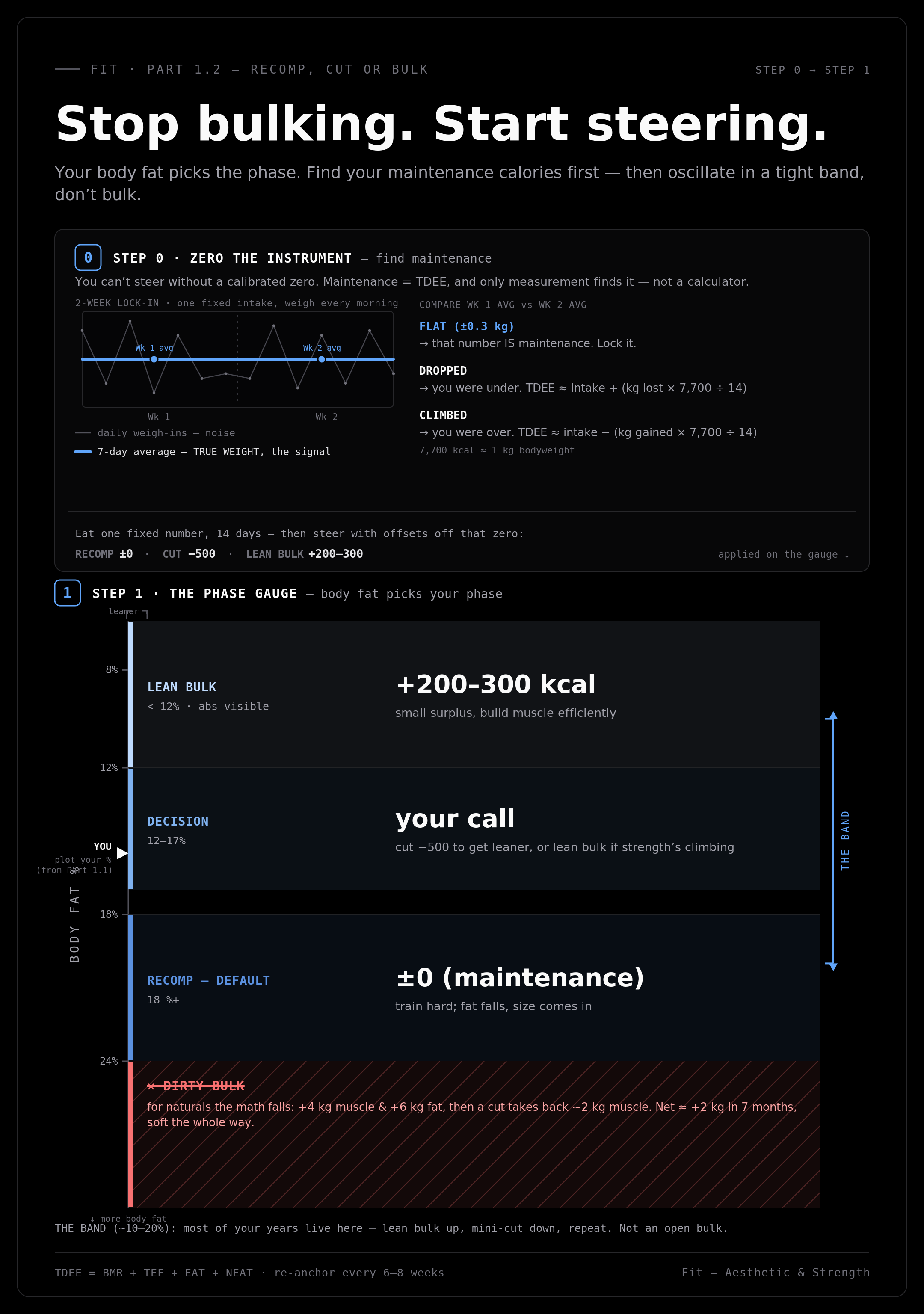
Now that you have your baseline from Part 1.1, it’s time to put in the work. You cannot pick a direction—Bulk, Cut, or Recomp—if you don’t know where “stationary” is.
Your goal is to have your True Maintenance Calories locked in by the end of Week 2. Once you have that anchor, you aren’t just guessing; you are forecasting.
The Fitness Forecast
Now that you have your baseline from Part 1.1, it’s time to put in the work. You cannot pick a direction—Bulk, Cut, or Recomp—if you don’t know where “stationary” is.
Your goal is to have your True Maintenance Calories locked in by the end of Week 2. Once you have that anchor, you aren’t just guessing; you are forecasting.
Use this simple template to visualize your trajectory once your maintenance is found:
| Week | Phase | Calorie Delta | Predicted BF% | Performance Goal |
|---|---|---|---|---|
| 1-2 | Lock-in | ±0\pm 0 ±0 (Maintenance) | Baseline | Form Mastery |
| 4 | Execution | +200+200 +200 or −500-500 −500 | −0.5%-0.5% −0.5% or +0.1%+0.1% +0.1% | +2.5+2.5 +2.5 kg on Main Lift |
| 8 | Review | Adjusted | Trend Analysis | New Rep PR |
Part 1.2 Takeaways
Key concepts to internalize
- Recomp is the default, not bulking. For naturals at 18%+ body fat, eating at maintenance and training hard beats the bulk-cut cycle on net muscle gained over a year.
- The decision tree is body-fat-driven. ≥18% → recomp. 12–17% → choose your priority. <12% with visible abs → lean bulk small (+200–300 kcal).
- Rule 1 — True weight: Daily weight is noise. The 7-day rolling average is signal. Compare averages, never single days.
- Rule 2 — Insulin activation: Big spikes belong around training and movement. Low baseline belongs the rest of the day. Both signals — insulin AND muscle contraction — must fire together for GLUT4 to do its job.
- TDEE = BMR + TEF + EAT + NEAT. Calculators are a starting estimate; only the 2-week lock-in tells you your real number.
- Re-anchor every 6–8 weeks. TDEE drifts as bodyweight, muscle mass, and adaptation change.
Your Week 1–2 Task List
Before moving on to Part 2, lock in your maintenance number. Without this anchor, every later decision is guesswork.
- Estimate starting TDEE — Use Mifflin-St Jeor with an activity multiplier of 1.4–1.7 depending on training frequency. Write the number down.
- Set the daily calorie target — Eat that exact number every day for 14 days. No “training day vs. rest day” variation. Same target, same protein, same carb-fat ratio.
- Weigh in every morning — Same conditions: post-bathroom, pre-water, pre-food, similar clothing. Record every reading.
- Calculate Week 1 and Week 2 averages — At the end of each 7-day block, average the seven readings. Compare Week 2’s average to Week 1’s.
- Apply the adjustment formula — Use the table in The lock-in protocol to adjust to true maintenance. That number is your anchor for the next 6–8 weeks.
- (Optional) Download MacroFactor — If manual averaging feels heavy, MacroFactor automates the entire flow. Worth it for most people.
- Pick your phase — Use the decision tree and your DEXA/InBody body fat number from Part 1.1 to choose recomp, cut, or lean bulk. Document the choice.
Up next For how to structure the day around all this — when to eat, when to train, when to walk, how to track — go to Part 2 — Structure of a Day.
To skip ahead to programming, go to Part 3.1 — The Program: Concepts.
For the pharmacology side, go to Part 4 — Pharmacology.
Disclaimer Not medical advice. Everything here reflects personal experience and reading of the research. Consult a medical professional before making significant changes to diet, training, or supplement protocol — especially with underlying health conditions.
Sources & references
Footnotes
-
On natural lifter cut strategy and the muscle catabolism risk, see outlift.com — bulk or cut and rippedbody.com — cut or bulk. ↩
-
Weight trend smoothing approach used by MacroFactor and similar apps; underlying principle of using rolling averages to extract signal from noisy daily weights is standard in body composition tracking. ↩
-
GLUT4 mechanism: muscle contraction activates GLUT4 translocation independently of insulin, producing additive effect when both signals fire. See review at PubMed Central — PMC8372753 and overview at bellyproof.com — advanced hypertrophy mechanics. ↩